
Master Email Marketing for Coaches in 2026
Master email marketing for coaches. Build your list, automate sequences, write compelling copy, and convert subscribers to clients.
If you're a coach, there's a good chance your pipeline feels uneven right now. One month you get referrals, discovery calls, and warm replies. The next month you're posting constantly, checking DMs, and wondering why interest went quiet.
That feast-or-famine cycle usually has one root problem. Too much of the business depends on channels you don't control. Social reach changes. Referral flow slows down. People see your work once, mean to come back, and forget.
Email fixes that when you use it correctly. Not as a newsletter you send when you remember. Not as a freebie follow-up that ends after three emails. Used well, email marketing for coaches becomes the system that carries a prospect from first contact to booked call, from signed client to successful onboarding, and from completed engagement to renewal, referral, or reactivation.
Why Email Is Your Most Valuable Coaching Asset
Coaches often treat email as a side channel. They build a list, send occasional updates, and hope a few people click. That leaves most of the value on the table.
The stronger model is to treat email as infrastructure. It holds your audience, your trust-building process, your launch messaging, your onboarding communication, and your retention touchpoints in one place. That matters because most coaching content still frames email as a lead-generation and nurture channel, while missing retention, reactivation, referrals, and post-purchase upsells. A better approach is to use email as a client-success system, not just a client-acquisition tool, as noted in Emily Ağan's perspective on email marketing for coaches.
Owned attention beats borrowed attention
Your email list is one of the few business assets you fully control. You decide when to send, what to say, how to segment, and what offer to place in front of whom. That makes email more durable than relying on algorithmic reach or hoping former clients remember to mention your name.
I've seen coaches get stuck because they only ask one question: "How do I get more leads?" The better question is: "How do I move people through every stage of the relationship without rebuilding the wheel every month?"
Practical rule: If your sales depend on live posting, manual follow-up, and memory, you don't have a system. You have effort.
Email runs the whole client lifecycle
Think about what a healthy coaching business needs:
- New subscriber capture through lead magnets and forms
- Trust building through educational and belief-shifting emails
- Sales conversion through focused launch and invitation sequences
- Client onboarding through expectation-setting and logistics
- Retention and expansion through check-ins, renewals, referrals, and next-offer invitations
That is why email marketing for coaches works best when it's built like an operating system. If you want a useful outside view of how lifecycle email supports revenue, especially on the B2B side, this guide on strategic B2B email for revenue ops is worth reading.
Most coaches don't need more random tactics. They need one system that keeps working when they're coaching, selling, resting, or delivering.
Building Your High-Value Email List from Scratch
A coach publishes for months, picks up subscribers, and still gets almost no consultations from email. The usual problem is not list size. It is list fit.
A high-value list is a list of future clients, past clients, referral partners, and warm readers who can move through your entire client lifecycle. That includes people who are still deciding, people who just bought, and people who may renew or refer later. If your opt-in attracts the wrong audience, every email after that gets harder to write and harder to monetize.
Start with the client, not the freebie
Before writing a lead magnet, get specific about who should join your list.
Use this four-part filter:
Filter
What to define
Example
Problem
The urgent issue they want solved
"I need more qualified leads for my coaching offer"
Stage
Where they are now
"Established coach with offers but inconsistent pipeline"
Goal
What outcome they want
"A predictable flow of booked calls"
Buying fit
Whether they can and will invest
"Already spending on growth, values support and speed"
This step affects more than list growth. It shapes your welcome sequence, your sales emails, your onboarding, and your retention offers. A subscriber who joins for a generic productivity checklist rarely turns into a premium coaching client. A subscriber who joins for a resource tied to the exact problem you solve often does.
A few examples:
- Executive coach: decision filter for high-stakes meetings
- Health coach: 7-day habit reset with a daily check-in tracker
- Business coach: lead qualification worksheet before a sales call
- Career coach: promotion readiness self-assessment
Specific gets better buyers.
Build opt-ins that pre-qualify people for the paid offer
The best lead magnets create a small result and expose the gap your coaching solves. They should help the reader act, not just consume.
A weak opt-in usually has one of these problems:
- It is broad enough to attract anyone
- It solves a problem you do not get paid to solve
- It gives information without creating momentum toward your offer
- It attracts DIY subscribers who want free tactics but not support
A stronger opt-in does three jobs at once:
- It earns attention
- It qualifies the subscriber
- It sets up the next conversation
For example, a confidence coach could offer "30 Journal Prompts for Self-Belief." That may grow the list, but it does little to identify who is ready to buy. "The 10-Minute Visibility Challenge for Women Leaders Speaking Up at Work" is narrower, more useful, and closer to a paid coaching decision.
If you want to improve conversion at the form level, review these examples of high-converting opt-in forms. Placement, message match, and friction matter more than adding extra fields or clever design.
A lead magnet should make the right person say, "This is for me," and make the wrong person ignore it.
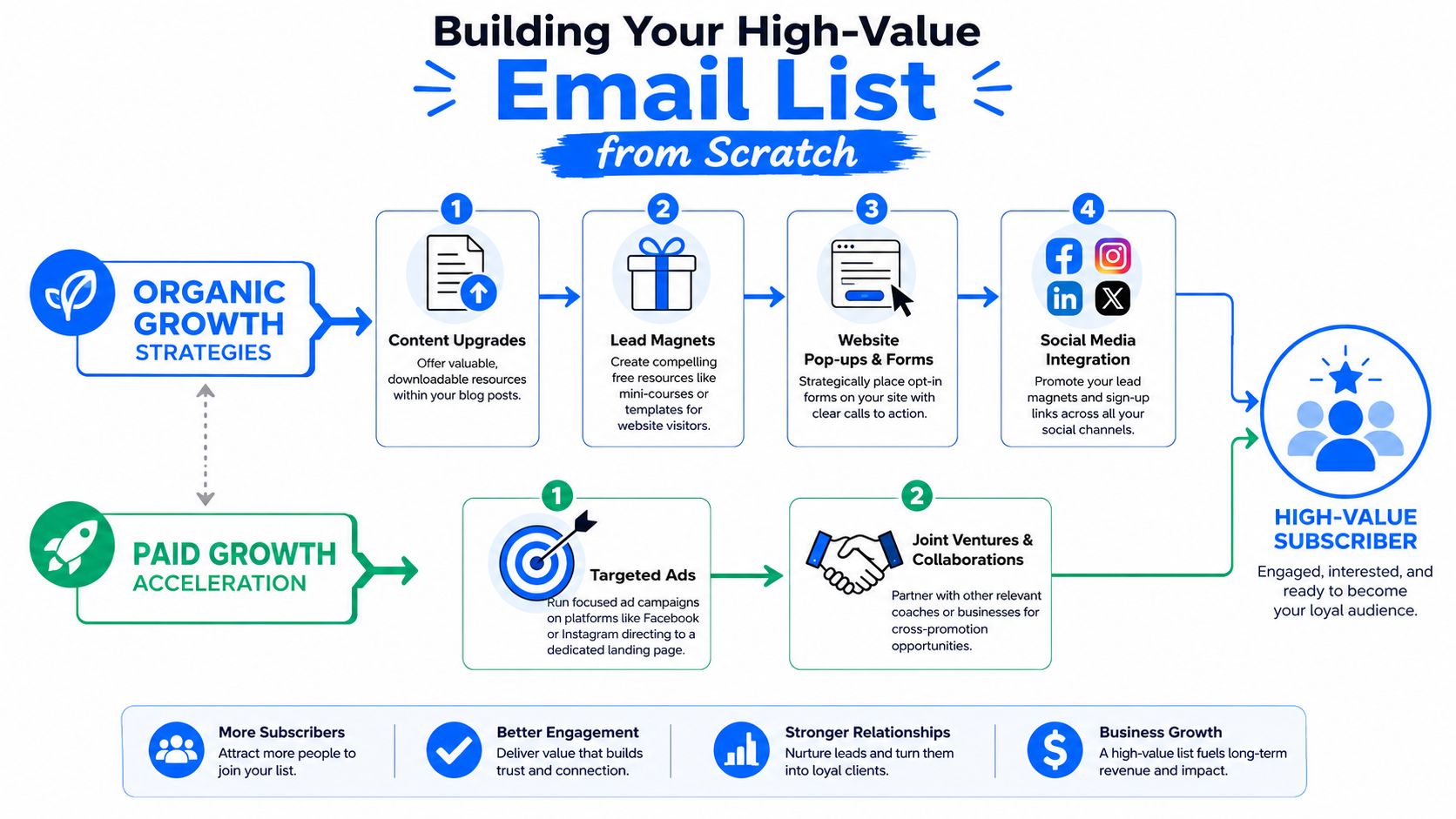
Organic growth that attracts buyers
Organic list growth works best when each channel points to one clear next step. Coaches lose momentum when every post, podcast interview, and website page promotes a different freebie.
Keep the system tighter than that.
Use a short set of entry points:
- A lead magnet tied to one paid offer
- A relevant content upgrade on high-intent blog posts
- A signup form on your homepage and service pages
- One social CTA repeated consistently for 30 to 60 days
- A workshop or webinar registration page for people closer to buying
This is where trade-offs matter. A broad opt-in may bring in more subscribers. A narrow opt-in usually brings in better sales conversations. Early-stage coaches often need the second one more.
If you want more examples of niche-specific list building, this guide on email strategies for coaches is useful.
Paid growth without filling your list with the wrong people
Paid list building can work well for coaches, but only if the traffic source, promise, and follow-up match. Cold traffic responds poorly to "join my newsletter." It responds better to a clear problem, a focused resource, and a clear next step.
A simple paid flow looks like this:
- Run targeted ads to a dedicated landing page.
- Offer one resource tied to one painful problem.
- Send a short follow-up sequence that asks for a reply, a click, or an application.
- Watch who engages, then segment those subscribers for sales follow-up.
Partnerships can produce even better subscribers than ads. Guest workshops, podcast swaps, referral partners, and bundle collaborations bring borrowed trust with them. That often leads to better reply rates and faster conversions, especially for coaches selling higher-ticket offers.
The goal is not a bigger database. The goal is a list that supports the whole business, from first touch to signed client to repeat engagement and referrals.
Crafting Your Signature Automated Email Sequences
Automation should remove friction, not personality. The coaches who get the best results from email rarely automate more. They automate the right conversations.
A common failure is building a welcome sequence once and forgetting it. The smarter approach is to treat it as a measurable system. Coaches should segment by subscriber interests and engagement level, then review open, click-through, and bounce-rate patterns regularly to refine timing, content, and offers. Weak list hygiene and undifferentiated messaging reduce engagement and deliverability over time, as discussed in this guide on how business coaches can leverage email marketing.
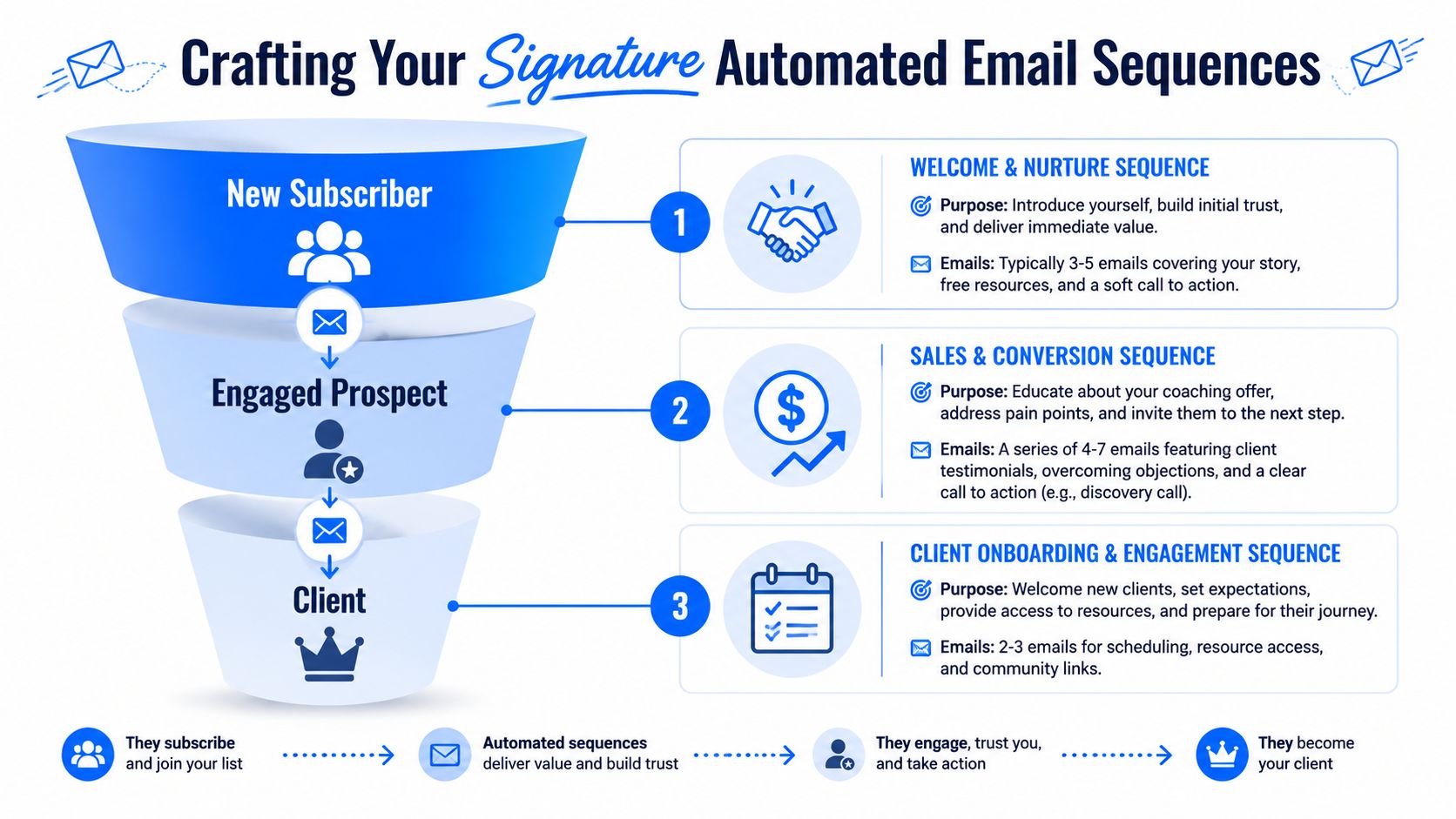
Start with three core sequences. If these work, the rest of your system gets easier.
Welcome and nurture sequence
This sequence turns a new subscriber into an engaged prospect. It shouldn't read like a brochure. It should create momentum.
A simple structure:
- Email one: Deliver the lead magnet fast. Tell them what to expect next.
- Email two: Share the problem behind the problem. Teach one idea that reframes their situation.
- Email three: Show your method. Explain how you approach the issue differently.
- Email four: Address a common objection or mistaken belief.
- Email five: Invite a low-friction next step, like a reply, application, or call.
Example angle for a business coach:
- Email one subject: "Your pipeline worksheet is inside"
- Email two subject: "Why more content isn't fixing your sales problem"
- Email three subject: "The 3-part client acquisition system I use with coaches"
- Email four subject: "What to do if people are interested but not booking"
- Email five subject: "Want help applying this to your business?"
Don't dump your full life story into email one. New subscribers care less about your biography than your ability to help them make progress quickly.
A useful shortcut is to map each sequence before you write it. These email drip campaign templates can speed up that planning process.
After you've sketched the flow, watch this for additional sequence ideas and structure:
Sales and conversion sequence
When you open enrollment, stop sending vague "just checking in" emails. Your list needs a clear sales narrative.
Your sales sequence should do four jobs:
- Diagnose the pain so readers feel understood
- Clarify the offer so they know what you're selling and who it's for
- Handle objections around timing, fit, readiness, and hesitation
- Call for action with a direct invitation
Here is a practical seven-email launch structure:
Focus
Example CTA
1
Enrollment is open
Apply now
2
The cost of staying stuck
Book a call
3
What the program includes
Review details
4
Objection handling
Reply with questions
5
Who this is for and not for
See if it's a fit
6
Deadline reminder
Apply before close
7
Final call
Last chance to join
A weak sales sequence hides the offer until the end. A strong one names the problem, names the solution, and repeats the invitation without apology.
Client onboarding sequence
Most coaches stop emailing once someone pays. That's a mistake. Post-sale emails shape delivery, retention, and buyer confidence.
Your onboarding sequence should reduce uncertainty quickly. A new client shouldn't wonder where to go, what happens next, or how to prepare.
Use a short sequence like this:
- Welcome email with next steps, scheduling, and access links
- Preparation email with expectations, forms, or pre-work
- Momentum email that reinforces the decision and reminds them how to get the most from the coaching
Example onboarding email language:
You don't need to be perfectly prepared before we start. You do need to show up honestly, complete the prep, and bring real examples from your business or life. That's how coaching turns into change.
This is also where segmentation matters. A lead who clicked on sales emails but didn't buy should not receive the same messages as a newly signed client. Coaches who ignore these distinctions usually end up with cluttered automations, confusing subscriber journeys, and lower engagement across the board.
Your Weekly Content and Copy Playbook
Once your automated sequences are live, your weekly emails keep the relationship warm. Consistency matters more than volume. A widely cited best-practice pattern for coaches is sending about one email per week for steady engagement, while launch periods may use 5 to 7 emails over 7 to 10 days to enroll clients, according to AWeber's coaching email marketing guidance.
That weekly email should do one job well. Don't cram updates, inspiration, a sales pitch, five links, and a personal essay into every send.
Build around content pillars
Pick three to five recurring pillars tied to your offer. That removes the blank-page problem.
Examples by niche:
- Business coaching
- Sales conversations
- Offer design
- lead generation
- mindset under pressure
- Health coaching
- Habit consistency
- emotional eating triggers
- recovery after setbacks
- realistic routines
- Life coaching
- boundaries
- confidence
- transitions
- decision-making
- Relationship coaching
- communication patterns
- conflict repair
- dating standards
- trust rebuilding
You don't need a new idea every week. You need a familiar set of problems your audience wants help solving.
Use a simple weekly format
Rotate between these email types:
- Teach one thing
Share one concept, framework, or mistake. End with a direct takeaway.
- Tell a client-pattern story
Keep it anonymous and practical. Focus on what changed and why.
- Answer one question
Pull from discovery calls, client conversations, or replies.
- Make one invitation
Promote a call, workshop, waitlist, or paid offer when it's relevant.
A weekly email gets stronger when it sounds like a coach speaking to one person, not a marketer broadcasting to a crowd.
Subject lines and calls to action that work
Subject lines don't need to be clever. They need to be clear enough to earn attention.
Try formulas like:
- The mistake: "The sales mistake I see coaches make every week"
- The question: "Are your consults stalling at the same point?"
- The shift: "What changed when I stopped teaching for free"
- The direct result: "Why leads go cold after the first call"
For calls to action, avoid weak endings like "let me know your thoughts." Ask for a next step that matches intent.
If your goal is
Use a CTA like
Replies
"Hit reply and tell me what's blocking this right now."
Clicks
"Read the full breakdown here."
Bookings
"Apply for a call if you want help building this."
Segmentation
"Click the link that best matches where you are."
Weekly email content should create movement. A good send teaches, qualifies, or invites. The strongest ones do two of those at once.
Managing Deliverability and Staying Compliant
A lot of coaches think deliverability is a technical issue someone can fix later. It isn't. It's a business issue. If your emails don't land in the inbox, your nurture system, launches, onboarding, and retention emails all weaken at once.
This matters more now because the rules have tightened. Gmail and Yahoo began enforcing one-click unsubscribe, authenticated sending, and low complaint-rate expectations for bulk senders, and many coach-focused guides still skip the operational details that determine whether emails are delivered, as covered in Mailtrap's write-up on email marketing for online coaches.
Deliverability is trust in operational form
Coaches often focus on copy and offers, which makes sense. But inbox placement starts earlier. It starts with permission, relevance, and list hygiene.
If someone downloads a lead magnet and then gets a flood of mismatched promotions, they won't just ignore you. They may unsubscribe, mark the email as spam, or mentally tune out. Each one hurts the system.
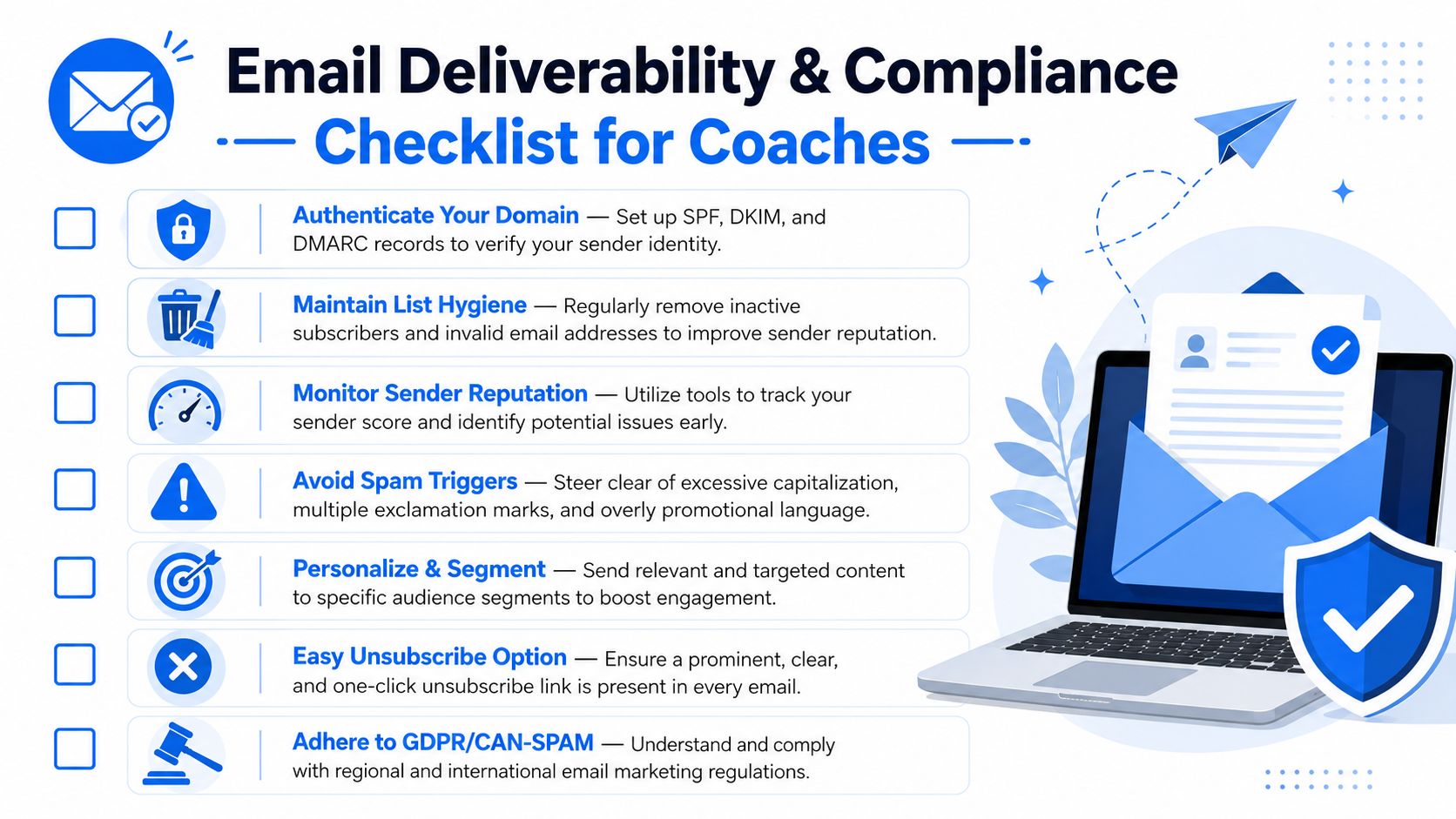
A practical checklist
Use this operating standard:
- Get clean consent. Only email people who clearly opted in.
- Honor unsubscribe requests fast. Make leaving easy.
- Keep segmentation current. Send based on interest and behavior, not convenience.
- Remove dead weight. Inactive and invalid contacts drag down performance.
- Watch for spam placement. If you're unsure, use tools that show how to check if emails are going to spam.
- Review your setup regularly. A platform with built-in hygiene and deliverability support can help. If you're comparing options, email deliverability best practices is a useful checklist, and platforms like Breaker also combine email sending with list growth and deliverability management.
Compliance isn't just about avoiding trouble. It protects the relationship with your audience. People trust coaches with personal information, career goals, health struggles, money decisions, and private fears. Respecting consent is part of the service.
Measuring What Matters for Client Growth and Revenue
A coach sends emails every week, sees decent opens, and assumes the system is working. Then they check the month and realize email produced no consultations, no renewals, and no referrals. Activity went up. Revenue did not.
That gap usually comes from tracking channel metrics without tracking client movement.
Open rate and click-through rate still have a place. They help diagnose subject lines, audience interest, and whether readers are taking the next step. Website opt-in conversion rate also matters because it shows whether your list-building assets are attracting attention. But a coaching business grows when email moves someone through the full lifecycle: subscriber to prospect, prospect to client, client to repeat client, and client to referral source.
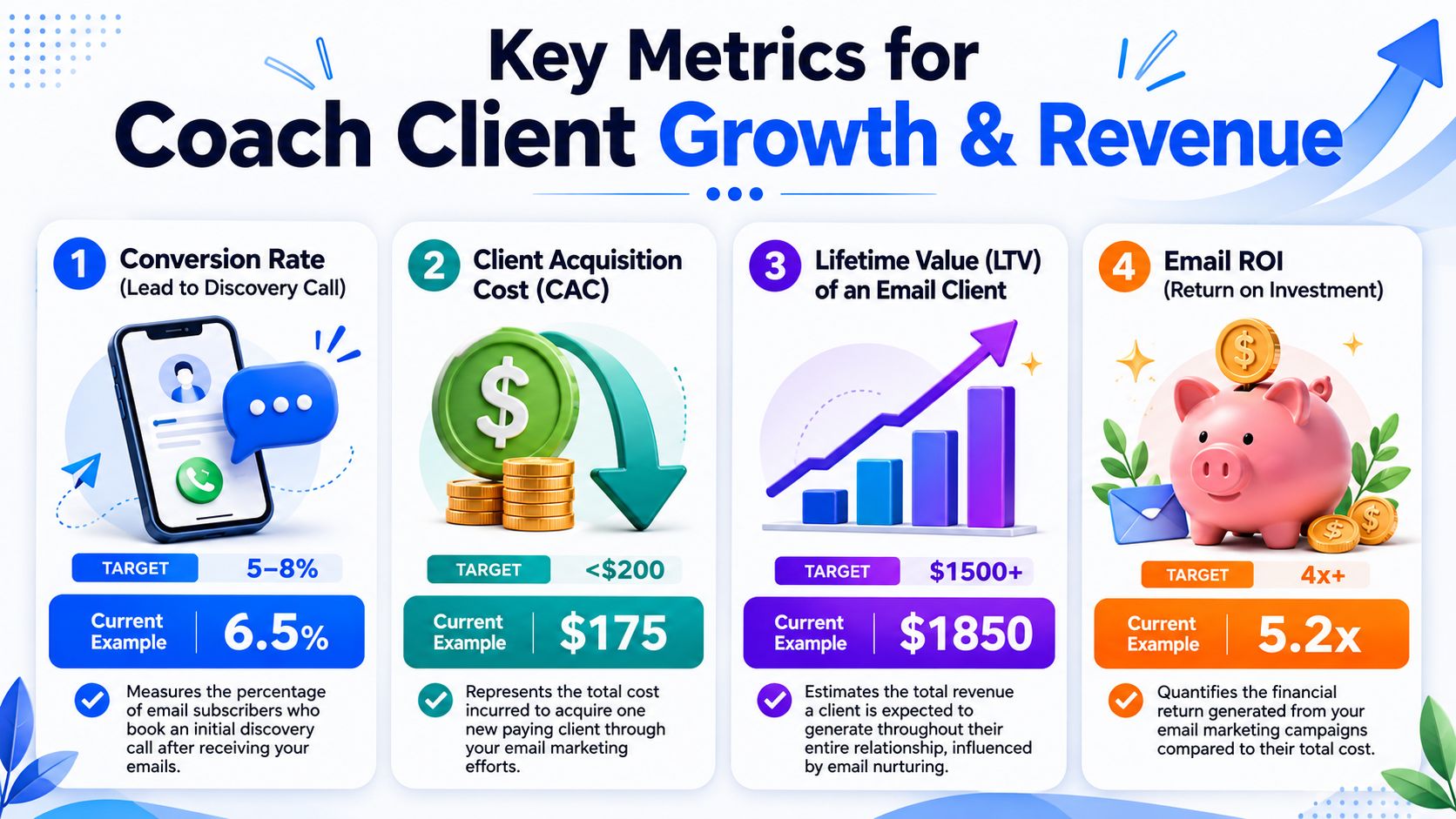
The numbers that actually guide decisions
Use email metrics in context. A welcome sequence with a strong open rate but no replies or bookings may be attracting curiosity, not buying intent. A smaller segment with lower opens but a steady stream of consult requests is often more valuable.
Look at performance by stage:
Stage
Better question
Why it matters
Acquisition
Are the right people subscribing?
Subscriber quality affects every later conversion
Nurture
Are subscribers clicking, replying, or showing intent?
Engagement shows interest and fit
Sales
Are emails generating consultations or applications?
This creates pipeline and revenue opportunities
Post-sale
Are clients staying engaged after buying?
Engagement after purchase supports results and retention
Expansion
Are former or current clients renewing, referring, or buying the next offer?
This raises client lifetime value
This view changes decisions fast.
A coach with 1,000 subscribers, 8 booked calls, and 2 renewals from email has a healthier system than a coach with 10,000 subscribers and no clear path from send to sale.
A monthly scorecard that helps you make better decisions
Review this once a month or after any major campaign.
- Subscriber source quality. Which lead magnet, webinar, podcast, or referral source brought subscribers who later clicked, replied, booked, or bought?
- Sequence performance. Which welcome, nurture, sales, onboarding, or check-in emails moved people to the next step?
- Offer-message fit. Which themes created replies, applications, or direct questions about working together?
- Booking contribution. How many discovery calls, consults, or applications started from an email click or reply?
- Client lifecycle contribution. Which emails led to renewals, upsells, referrals, testimonials, or reactivation of past clients?
This is the difference between publishing emails and operating an email system.
Track the job of each email. A nurture email should earn attention or replies. A sales email should produce applications, consults, or sales page visits. An onboarding email should reduce friction, improve attendance, and set expectations. A retention email should keep clients engaged between sessions. A referral email should prompt introductions while the client is still getting results.
How to measure ROI without building a complicated dashboard
Keep attribution simple at first. Use tagged links. Ask on intake forms how people found you. Record which sequence or broadcast was active before the person booked. If someone replies to an email and becomes a client, count that. If a past client returns after a re-engagement campaign, count that too.
Over time, patterns become obvious. Some lead magnets bring subscribers who read but never buy. Some topics produce fewer clicks but more qualified replies. Some onboarding emails reduce confusion and improve retention. Some client check-in emails open the door to upsells or referrals because they arrive at the right moment.
That is how email becomes a client growth system instead of a content habit. The goal is not more metrics. The goal is a clearer line between what you send and how people move through your business.
If you want a platform that supports both sending and audience growth in one place, Breaker is built for that workflow. You can create campaigns, manage newsletter performance, and grow a targeted subscriber base while keeping analytics, list hygiene, and deliverability in view. For coaches who want email to function as a full client lifecycle system instead of a disconnected set of tools, it's a practical place to start.
Keep reading
All articles8 Best Email Tracking Software Tools in 2026
Compare 8 top email tracking tools for 2026, how tracking pixels work, and why Apple's privacy rules make open rates unreliable. See our top pick.
6 Best Email Trackers for Newsletter Senders in 2026
Open rates lie. Learn how email trackers really work, why Apple and Gmail skew the data, and which tools newsletter senders should actually use in 2026.
Post Webinar Survey: Questions, Examples, and a Checklist
What to ask in a post webinar survey, when to send it, three example formats, and a checklist for turning the answers into segmented follow-up and pipeline.