
Boost with email a survey: A 2026 guide
Discover how to email a survey that gets opened and answered, with proven B2B timing and design tips to boost responses in 2026.
When you need to email a survey, don't just think of it as a delivery system. See it for what it really is: a direct line to your most engaged B2B audience. Your newsletter subscribers are already in a space they check daily, making it the perfect channel to maximize response rates and get the high-quality data you need.
Why Email Is Your Secret Weapon for Surveys
Let’s be real—getting customer feedback often feels like shouting into a void. Social media polls are gone in a flash, and website pop-ups just feel intrusive. But one channel consistently delivers quality insights in a B2B setting: email.
Why? Because email is a professional’s digital home base. It's where business gets done, decisions are made, and people actually focus. Unlike the endless scroll of a social feed, the inbox is personal and direct. This gives you a prime opportunity to gather thoughtful feedback from your most valuable contacts.
The Power of the Inbox
Your newsletter subscribers are a pre-qualified, engaged audience. They’ve already given you permission to be in their inbox, which signals a level of trust and interest. When you send a survey to this group, you're not interrupting their day; you're inviting them into a conversation about a brand they already care about.
The scale of email is just massive. By 2025, an estimated 376 billion emails will be sent and received daily worldwide. For B2B growth teams and newsletter creators using a platform like Breaker, this just highlights the opportunity to cut through the noise with a well-crafted survey. In fact, targeted survey campaigns can hit open rates averaging 42%, which blows generic email blasts out of the water. You can dig deeper into the latest email marketing statistics to see the full potential.
Don't think of it as "sending a survey." Think of it as starting a dialogue with your most valuable community members, using their feedback to directly shape your product or content strategy.
Email's Strategic Advantage
Email gives you benefits that other channels just can't offer for gathering deep intelligence. You have total control over the audience, timing, and presentation, which all leads to better, more actionable data.
Here’s why email is the superior choice for surveys:
- Direct Access: It’s a direct line to your audience, no algorithms getting in the way and limiting your reach.
- Segmentation: You can easily target specific segments of your list—like power users or new subscribers—to ask highly relevant questions.
- Deeper Insights: The format allows for more than a simple poll. You can mix rating-scale questions with open-ended ones to get richer feedback.
- Relationship Building: Following up and sharing results shows participants their input is valued, which helps strengthen your community.
By embracing the various advantages of email marketing, you can turn a simple survey from a data-collection chore into a powerful engine for growth.
Setting the Stage for a High-Response Survey
Before you even think about writing a single question, you need a plan. Sending out an email survey without a clear goal is like setting sail without a map—you'll collect data, but you'll have no idea if it’s leading you anywhere useful.
It all starts with one simple question: What decision will this survey help me make?
Your answer to that question will shape everything that follows. If you're a B2B SaaS company thinking about a new integration, your goal is to see if your power users actually want it. If you're trying to figure out why subscribers are leaving, your goal is to find the friction points causing them to churn. Getting this crystal clear from the jump is non-negotiable.
Define Your Core Objective
A vague goal like “get customer feedback” is a recipe for disaster. It’s too broad and will only get you generic, unhelpful answers. You need to be specific and tie your objective to a real business outcome.
Here are a few examples of what this looks like in the real world:
- For a product marketer: "Determine if customers would pay for a new 'Advanced Analytics' feature."
- For a newsletter creator: "Identify the top three content topics our subscribers want to see next quarter to inform my editorial calendar."
- For a customer success team: "Understand the primary drivers of dissatisfaction for users who churned within their first 90 days."
See the difference? Each one is laser-focused on a specific outcome. This is how you get true business intelligence from your surveys, not just a collection of interesting-but-useless data points.
Target the Right Audience
Once you know why you're sending the survey, the next question is who you're sending it to. Blasting your entire email list is almost always a mistake. It tanks your engagement rates and floods you with irrelevant feedback.
This is where smart audience segmentation becomes your best friend.
Sending a survey about an advanced feature to brand-new trial users is a waste of everyone's time. Smart segmentation ensures you're asking the right people the right questions at the right time.
For instance, that B2B SaaS company vetting a new integration should only survey "power users" who have actually used their API. If you’re a newsletter operator planning content, you could segment your list by engagement and poll your most active readers to learn what keeps them hooked.
Of course, this only works if your contact list is clean and well-organized. For a deeper dive on that, check out our guide on maintaining excellent email list hygiene.
Choose the Right Survey Format
Different goals call for different survey types. Picking the right format is key to collecting data that actually helps you make the decision you defined earlier. You wouldn't use a simple satisfaction score to make a complex product roadmap decision, right?
Here’s a quick look at the most common survey types and what they’re good for.
Choosing the Right Survey Type for Your Goal
Survey Type
Best For
Example Question
NPS (Net Promoter Score)
Measuring overall customer loyalty and brand sentiment.
"On a scale of 0-10, how likely are you to recommend our product to a friend or colleague?"
CSAT (Customer Satisfaction)
Gauging satisfaction with a specific interaction or feature.
"How satisfied were you with your recent support experience?"
Open-Ended Questions
Gathering qualitative insights, ideas, and detailed feedback.
"What is the one thing we could do to improve our newsletter for you?"
Matching the right format to your goal is the final piece of the planning puzzle.
With a clear objective, a targeted audience, and the right survey type locked in, you’ve laid the groundwork to email a survey that not only gets responses but also delivers truly actionable results.
Crafting an Email and Survey That People Want to Answer
The design of your survey and the email that gets it there can make or break your entire campaign. A clunky, frustrating survey gets you junk data, while a boring email gets ignored completely. The goal is to create an experience that feels effortless and inviting, so subscribers actually want to share their feedback.
The best surveys don't feel like a chore. They're logical, to the point, and respect your audience's time. It’s always tempting to ask everything you can think of, but resist the urge. Getting 100 solid responses to 10 great questions is infinitely more valuable than getting 10 half-finished responses to a 100-question monster.
Remember, your audience is busy and most likely reading your email on a smartphone. Mobile-friendliness isn't just a nice-to-have; it's a non-negotiable. Your survey layout needs to be clean, with large, tappable buttons and text that’s easy to read on a small screen. Always test it on your own phone before you hit send.
Design Questions for Honest Answers
The quality of the data you collect is a direct result of the quality of your questions. You're aiming for honest, thoughtful responses—not trying to lead people to the answer you want to hear.
This means you have to avoid biased or loaded questions. Asking something like, "How much did you enjoy our amazing new feature?" is a surefire way to get inaccurate data. It pressures the respondent and signals that you aren't actually interested in real critique.
- Be Neutral: Rephrase the question so it's completely objective. "How would you rate your experience with our new feature?" works much better.
- Be Specific: Don't lump unrelated ideas together. A question like, "Was our support team fast and helpful?" is flawed. They could have been fast but useless, or helpful but slow. Split it into two separate questions to get clear, actionable insights.
- Keep it Simple: Ditch the internal jargon and use plain language. Your questions should be instantly understandable to anyone, not just the people on your team.
This simple flow chart really breaks down the first few crucial steps for any survey campaign.
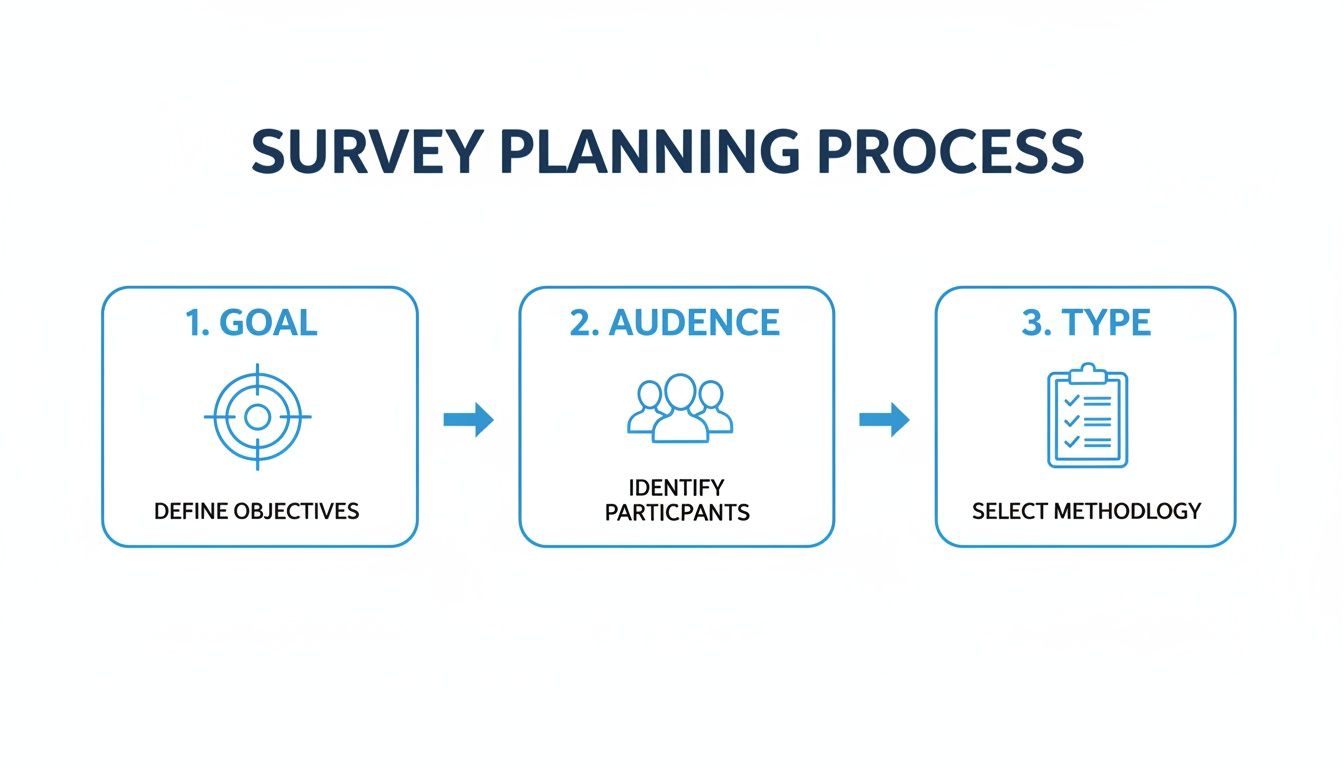
When you start with a clear goal, every question you write has a purpose. And when you know exactly who you're talking to, you can be sure you’re asking the right people.
Write Emails That Drive Clicks
Your email is the front door to your survey. It doesn't matter how brilliant your questions are if nobody ever clicks through to see them. Your subject line and call-to-action (CTA) are the two most important levers you can pull here.
When it comes to subject lines, clarity and a touch of personalization are your best friends. Using the subscriber's first name or your brand name helps it stand out in a crowded inbox. Words like "quick" or "brief" are great for managing expectations. You could even get specific: "Got 3 minutes for us, \First Name]?" When you're ready to write yours, it's a good idea to run your copy through a [subject line tester to optimize open rates.
As you think about how to structure your message, good frameworks can help you create an effective email that gets your point across. For your CTA, stick to clear, action-oriented language. "Take the Survey" or "Share Your Feedback" is so much stronger than a vague "Click Here."
Pro Tip: Embed the very first question of your survey directly into the email itself. A simple rating scale or a multiple-choice question that users can answer with a single click dramatically lowers the barrier to entry. This one-click action hooks them, making it much more likely they'll go on to complete the rest of the survey.
This approach really works. Automated email flows, like those that can include embedded surveys, typically see 48.57% open rates and 4.67% click-through rates (CTR). This is especially powerful for newsletter creators. Using a platform like Breaker with TruSend deliverability ensures your survey emails land in the primary inbox 86% of the time, assuming you're practicing good list hygiene.
Getting Your Survey Seen: How to Optimize Your Send
So you’ve built the perfect survey. Don’t pop the champagne just yet. Hitting ‘send’ is just the start—the real work is making sure your email actually gets seen and opened. The best survey in the world is worthless if it’s buried in a spam folder or sent while your audience is sound asleep.
It all starts with something that sounds boring but is absolutely critical: email deliverability. You can write a subject line that sings and target the perfect audience, but none of it matters if your emails don't reliably hit the inbox. The first step, always, is maintaining a clean list by scrubbing out inactive or invalid addresses.
And to stand out in a crowded inbox, you need to nail the fundamentals. Brushing up on current email subject line best practices is non-negotiable. It’s what gets your foot in the door.
Finding the Perfect Send Time
Forget the generic advice you’ve heard about sending emails on Tuesday at 10 AM. The right time to send depends entirely on your audience and their habits. Are you surveying B2B finance pros? They’re probably checking emails before the market opens. Targeting tech workers on the West Coast? A late morning send might be your best bet.
Your own data holds the answers. Dive into your email platform’s analytics.
- Check Past Campaigns: When have your emails historically seen the highest open and click rates? Start there.
- Segment by Time Zone: If you have a global subscriber list, don't send a blast at one time. Segment your send by geography to hit each region’s local morning sweet spot.
- Test and Measure: Don't be afraid to experiment. Send one batch at 9 AM and another at 1 PM. Let the response rates tell you which one worked better.
Your audience's habits aren't set in stone. Revisit your send-time data regularly to ensure your strategy is still effective. A simple tweak can give you a serious lift in responses.
The Art of the Follow-Up
Most people are busy. They see your email, mean to respond, and then get pulled into a meeting. That’s why a single, well-timed follow-up is your secret weapon. Sending one reminder can boost your total response rate by 20-30% without coming across as pushy.
Wait about three to five days, then send a reminder to anyone who hasn't responded. The key is to be helpful, not demanding. A simple subject line like, "Quick reminder: share your feedback" often works wonders. In the body, just restate the value of their input and drop the survey link in again.
Using Incentives Wisely
So, should you offer a prize for completing your survey? It depends. While incentives can definitely boost participation, they also risk attracting people who just want the freebie, leading to rushed, low-quality answers.
Here’s how I think about it:
- For Engaged Audiences: If you have a loyal community, like your newsletter subscribers, a simple "thank you" and a promise to share the findings is often enough. Their reward is helping a brand they already trust.
- For Broader Audiences: When you need a higher volume of responses, a small, relevant incentive can work miracles. Think about offering a discount, exclusive content, or entry into a drawing for a desirable prize. Steer clear of generic cash rewards, as they’re notorious for attracting low-quality feedback.
Looking ahead, AI-powered tools are poised to make this entire process even smarter. Projections show that 87% of marketing teams will be using AI in their email workflows by 2026. This tech is already integrating into platforms like Breaker, where surveys can automatically help grow a newsletter list, tapping into the 70% of people who use email every month. You can dig into more future email marketing statistics and trends on blog.robly.com.
Turning Survey Results into Actionable Insights

The moment your survey closes, the real work begins. Raw data is just a jumble of noise; your job is to find the signal and turn it into a clear plan. The most effective way to start is by separating your feedback into two distinct buckets: quantitative and qualitative.
Quantitative data covers all your numbers—the rating scores, yes/no answers, and multiple-choice selections. Start by calculating averages and looking for the obvious patterns. For instance, if you ran a content preference survey, which topic scored the highest average rating? This gives you a quick, high-level view of what’s hitting the mark and what isn’t.
Qualitative data, on the other hand, comes from your open-ended questions. These text-based answers are where you’ll find the “why” behind the numbers. As you read through the responses, keep an eye out for recurring themes, specific phrases, or common pain points. This is where the real gold is hidden.
Connecting Insights to Business Goals
Once you’ve spotted the key trends, it’s time to tie them directly to your business goals. Insights without action are just interesting trivia. This part is all about creating a concrete plan based on what your audience just told you.
Let’s say you’re a newsletter creator, and your survey data shows a strong desire for more case studies. That’s your signal.
- Action: Plan your next quarter’s editorial calendar around two new case study-focused articles.
- Goal: Increase reader engagement and time-on-page metrics by giving them content they explicitly asked for.
Or, if you’re a B2B marketer and the feedback reveals confusion around a new product feature, don't just sit on that information.
- Action: Create a task to schedule a meeting between the product and marketing teams to review the feedback.
- Goal: Develop a clear plan to improve user onboarding, whether through new help docs, a tutorial video, or in-app guides.
The most crucial step is to close the loop. Send a follow-up email to your participants summarizing the key findings and explaining the changes you’ll be making based on their input. This shows them their time was valued and that their voice truly matters.
This final communication is what turns a one-off survey into a powerful community-building tool. When you email a survey and actually follow through, you prove that you’re listening. That builds immense trust and makes subscribers far more likely to participate again in the future. It’s the difference between just collecting data and actively building a relationship.
Common Survey Email Questions Answered
Even the most well-laid survey plan hits a few practical snags right before launch. You've got the strategy, but now you're sweating the small stuff. This is where most marketers get stuck. Let's clear up some of those nagging last-minute questions so you can hit "send" with confidence.
What Is a Good Response Rate for an Email Survey?
Everyone wants a magic number, but the honest answer is: it depends. For a standard external survey to a broad customer list, hitting a 10-15% response rate is a solid win.
But for a highly engaged group, like your B2B newsletter subscribers? You should be aiming much higher. Think 20-30% or even more. These people already know and trust you, so they're more inclined to share their thoughts.
The real goal is to get better than your last survey. Simple moves, like personalizing the email or embedding that first question, will get you there.
Remember, a "good" rate is one that gives you enough data to make confident decisions. A 15% response from a 10,000-person list is far more insightful than a 50% response from a 100-person segment.
How Long Should My Email Survey Be?
Keep it short. Seriously. Your audience is busy, and their time is valuable.
The sweet spot is 5-10 questions that can be wrapped up in 3-5 minutes. Anything longer, and you'll see a massive drop-off rate.
Always set expectations upfront in the email invitation. A simple line like, "Got 3 minutes to share your thoughts?" does wonders for your click-through rate because it removes the fear of a long, tedious questionnaire. If you absolutely need more data, break it up. Send a series of shorter, focused surveys over time instead. This is way more effective, especially for professionals checking email on their phones.
Should I Offer an Incentive for Completing a Survey?
This is a tricky one. Incentives can definitely boost response rates, but they can also attract the wrong kind of feedback—people just clicking through for the prize. Your decision really comes down to who you're asking.
- For Engaged Audiences: If you're surveying loyal newsletter readers, their motivation is already there. A genuine "thank you" and a promise to share the results often works better than any prize. They want to be heard and feel like part of the community.
- For Broader or Colder Audiences: When you need sheer volume, a small, relevant incentive can work wonders. Think about offering exclusive content, a discount on your product, or entry into a drawing for something your audience actually wants. Steer clear of generic cash rewards—they tend to attract low-quality, thoughtless responses.
Ready to turn your B2B newsletter into a powerful feedback and growth engine? Breaker combines an intuitive email builder with automatic list expansion, helping you connect with your ideal audience. Start your free 7-day trial and see how easy it is to grow your list and revenue.
Keep reading
All articlesNewsletter Analytics: Which Metrics Actually Matter in 2026
Open rate and clicks don't predict buyers. Learn the 7-step method to track click depth, recency, and topic affinity for a revenue-predictive intent score.
Newsletter Segmentation Strategy: Increase Engagement in 2026
Build a data-driven newsletter segmentation strategy using behavior, intent score, and topic affinity to lift opens and clicks. Step-by-step guide.
How to Grow Newsletter Subscribers with Qualified Leads in 2026
Discover 8 channels to grow engaged newsletter subscribers in 2026, with real cost-per-engaged-subscriber data to focus your list-building strategy.