
Business Introduction Email: A Guide to Getting Replies
Learn to write a business introduction email that gets opened and answered. Our step-by-step guide covers subject lines, personalization, CTAs, and follow-ups.
You're probably doing one of two things right now. You're staring at a blank draft for an email to a prospect you want to hear back from, or you're rewriting the same opening line for the fifth time because it still sounds like everyone else's outreach.
That's the problem with the average business introduction email. Most of them are written from the sender's point of view. They lead with credentials, company blurbs, product language, or a generic “hope you're well” before they ever tell the recipient why this message landed in their inbox.
That approach loses fast.
A good business introduction email isn't a clever template. It's a context-delivery mechanism. The recipient opens it and immediately decides whether this is relevant, vague, or annoying. If you don't answer “Why me, why now?” almost immediately, the rest of the copy doesn't matter much.
The emails that earn replies usually do three things well. They establish context early, make the value legible without overexplaining, and ask for one small next step. Everything else is secondary.
The Modern Business Introduction Email
A prospect opens your email between meetings, reads the first two lines on a phone, and decides in a few seconds whether it deserves any more attention. That decision has less to do with your credentials than with clarity. Your recipient's inbox isn't short on messages. It's short on messages that explain, immediately, why this person is being contacted right now.
That shift changed the standard for a business introduction email. The older format led with pleasantries, background, and a polished company summary. The current version has a harder job. It needs to establish context fast enough for the reader to categorize the message before they delete it, ignore it, or save it for a later review that never happens.
In practice, strong intro emails answer two questions early: Why me, and why now?
That sounds simple, but it changes how the whole message is built. The sender stops trying to sound impressive and starts trying to make the email easy to process. In B2B outreach, reducing cognitive load is often the difference between a reply and a skim.
What changed
Buyers got faster at filtering. They scan for relevance cues, ownership, timing, and risk. If those signals are missing, even a well-written email feels like work.
The modern introduction email works best when it does four things in a clear order:
- Immediate context: State why the message reached this specific person.
- Reason for timing: Give the trigger, change, problem, or observation behind the outreach.
- Practical relevance: Connect the issue to something the recipient likely owns.
- Simple next step: Ask for one action that feels easy to answer.
This is also why recipient selection matters more than many teams admit. If the person is a weak fit, no amount of copy improvement fixes the underlying mismatch. A clear ideal customer profile in marketing gives the email a fair chance before writing even starts.
A business introduction email works when the recipient can place it in the right mental bucket without rereading the opening.
What still matters
Professional basics still affect reply rates, especially in industries where tone signals competence. Sloppy formatting, vague subject lines, and overfamiliar language create friction before the reader even evaluates the offer. If you want a clean reference for phrasing, structure, and common mistakes, RewriteBar's guide to business emails is useful.
The trade-off is straightforward. Brevity helps, but brevity without context reads like spam. Detail helps, but detail before relevance loses attention. The strongest business introduction emails stay short because they remove anything that does not help the recipient understand the point quickly.
If your opening starts with your company overview, the email is usually ordered the wrong way.
Define Your Goal and Recipient Context First
A VP of Marketing opens your email between meetings. In seconds, they decide whether it belongs in one of two buckets: relevant now, or ignore. That decision usually happens before they reach your third sentence.
Weak outreach often fails because the strategy is flawed, not the writing. Teams start with a template, swap in a first name, add a line about the prospect's company, and mistake that for relevance. It rarely works. If the sender has not defined the outcome and the reason this specific person should care right now, the copy has no clear job to do.
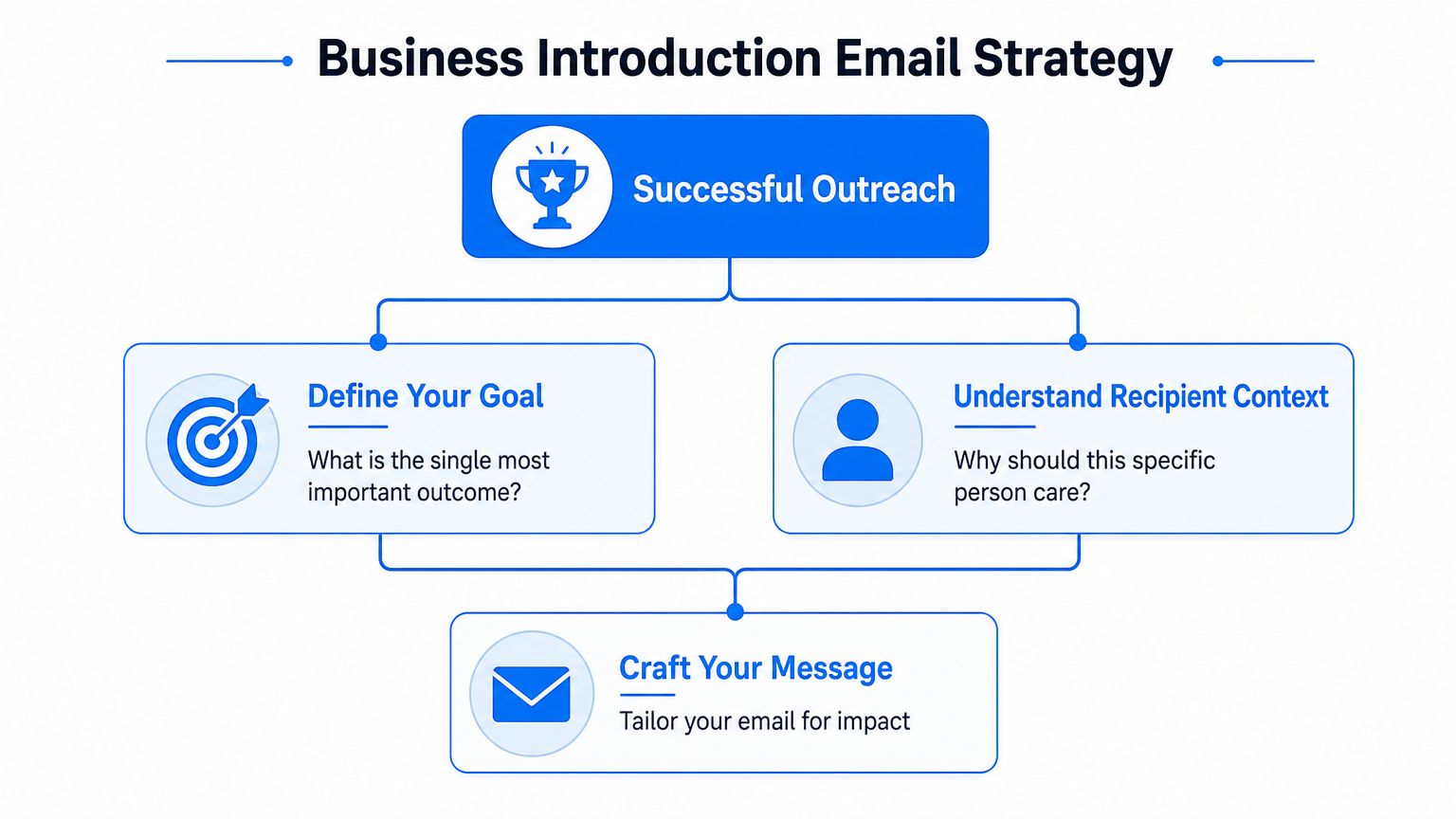
Start with one outcome
A business introduction email needs one target outcome.
Pick one and write toward it:
- A reply confirming relevance
- A referral to the right owner
- A light discovery call
- Permission to send something useful
- A response to a specific question
This sounds obvious, but it changes the whole message. An email asking for a meeting needs enough context to justify calendar time. An email asking, “Is this something you own?” can be much shorter and often gets more replies because the commitment is smaller. In cold outreach, that trade-off matters.
I usually see better performance when the ask matches the buyer's stage of awareness. If the recipient has no reason to know your company yet, asking for a 30-minute call is often premature. A short reply, a redirect, or permission to share a relevant resource is easier to earn first.
If your team handles both marketing-qualified and sales-qualified demand, clear stage definitions help. A team that knows what counts as curiosity versus buying intent writes tighter outreach and hands off leads with less confusion. Orbit AI's MQL and SQL guide for B2B is a useful reference if those definitions are still fuzzy.
Build recipient context before copy
The next question is the one recipients ask themselves as soon as they open the email: why me, why now?
Answer that in the first two sentences. This is the part many generic template guides miss. Clear context reduces cognitive load. The reader should not have to infer why they were selected, what changed, or what problem the email is tied to. If they have to work to place your message, reply rates drop fast.
Strong context usually comes from one of five places: the person's role, a company change, a visible initiative, a workflow problem they likely own, or a relationship path such as a referral or shared vendor. Surface personalization is weaker. Mentioning a city, a podcast appearance, or a line from the About page often signals that research happened, but not that the outreach is relevant.
Use context the recipient can recognize immediately.
Practical rule: If your first two sentences could be sent to fifty different people unchanged, you do not have enough context.
Here's the difference:
Context type
Weak version
Strong version
Role
“You're in marketing”
“You own lifecycle and outbound performance”
Company
“I saw your company online”
“Your team is expanding newsletter-led acquisition”
Trigger
“Reaching out to connect”
“Reaching out because your team just launched a new segment”
Problem
“We help businesses grow”
“You likely need more qualified engagement without more manual list work”
Recipient selection matters as much as wording. If the list is loose, the copy has to work too hard. A clear ideal customer profile definition for marketing teams improves reply quality before anyone writes a subject line.
One more constraint is worth keeping in mind. Business introduction emails work better when they get to the reason for outreach quickly and keep the ask light. As noted earlier, strong examples tend to stay concise and make the context obvious early, because that is what helps the reader decide without rereading.
Crafting the Three Critical Email Components
Your reply rate is decided by three parts of the message: the subject line, the opening, and the value proposition.
A recipient opens a cold email between meetings, scans the first lines, and decides in seconds whether it deserves attention. If the subject feels generic, the opening lacks context, or the value prop sounds like a canned pitch, the message is done. Short copy helps, but structure matters more. The right structure lowers the effort required to understand why the email showed up and whether it is worth answering.
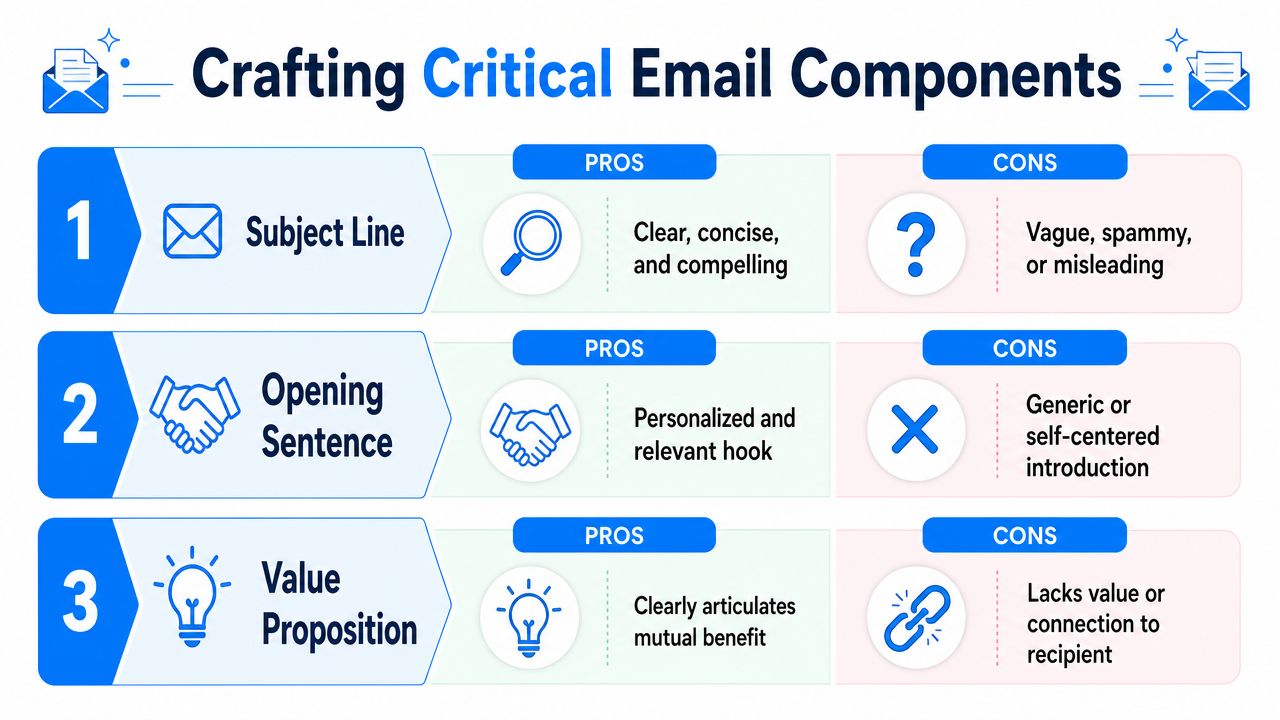
Subject lines that open without sounding automated
The subject line sets the tone before the body has a chance to do any work. In practice, the best ones read like a real person had a specific reason to write.
Personalization can help if it adds context. Zeliq's business introduction email guidance notes that using a recipient's name can improve opens, but the same piece also warns against overstuffed tokens and spam signals. That trade-off shows up constantly in outbound. A subject line that feels personalized earns a look. A subject line that feels assembled by software gets ignored.
Keep it plain and specific. Good subject lines usually point to a topic, problem, or initiative the recipient can place quickly.
What works better:
- “Idea for [Company] newsletter growth”
- “Question about onboarding emails”
- “[Name], quick thought on outbound follow-up”
What usually underperforms:
- “Transform your growth today!!!”
- “Congrats on your amazing success”
- “Let's connect”
For more real examples and patterns, this guide to email subject line best practices is useful to keep on hand.
Open with context, not pleasantries
This is the part generic template libraries often miss.
The first two sentences should answer two questions in the recipient's head: why me, and why now? If those answers are missing, the reader has to work to interpret the email. That extra effort kills replies.
A weak opening:
“Hope you're doing well. I wanted to introduce myself and share a little bit about what we do.”
A stronger opening:
“You oversee outbound pipeline quality at [Company]. Reaching out because your team appears to be investing in higher-fit top-of-funnel acquisition.”
That version works because it does the sorting for the reader. It identifies why this person was chosen and ties the outreach to a recognizable business context. The recipient does not have to guess whether the email is relevant.
In cold outreach, clarity beats warmth early. Polite is fine. Vague is expensive.
Value propositions that sound like help, not a pitch
Once the reader understands the context, the value proposition has one job: make the reply feel justified.
That means naming a concrete outcome, pressure, or bottleneck the recipient is likely dealing with. It does not mean summarizing the company, listing features, or claiming broad transformation. Early-stage outreach works better when the offer sounds narrow enough to be credible.
Compare these:
Weak value prop
Stronger value prop
“We're an AI-powered platform helping companies scale.”
“We help B2B teams turn newsletter and email into a qualified acquisition channel without adding manual list-building work.”
“Our solution improves engagement.”
“The workflow is built for teams that need cleaner targeting, faster campaign production, and fewer inbox placement issues.”
“Would love to show you a demo.”
“If this is relevant, I can send a short example of how similar teams structure the first-touch email.”
There is a real trade-off here. Specific value props reduce total addressable audience, but they improve reply quality because the recipient can recognize the fit faster. Broad claims feel safer to send and weaker to receive.
Personalization follows the same rule. Use company, role, or initiative details when they sharpen the case. Skip compliments and filler that do not help the reader understand why this message belongs in their inbox.
Designing a Low-Friction Call to Action
A surprising number of solid introduction emails die in the last line.
The sender does the hard part well. The message is relevant, concise, and clear. Then the CTA asks for too much: a meeting, a demo, a calendar commitment, or time “sometime next week.” That's a heavy lift for a first-touch email from someone the recipient doesn't know.
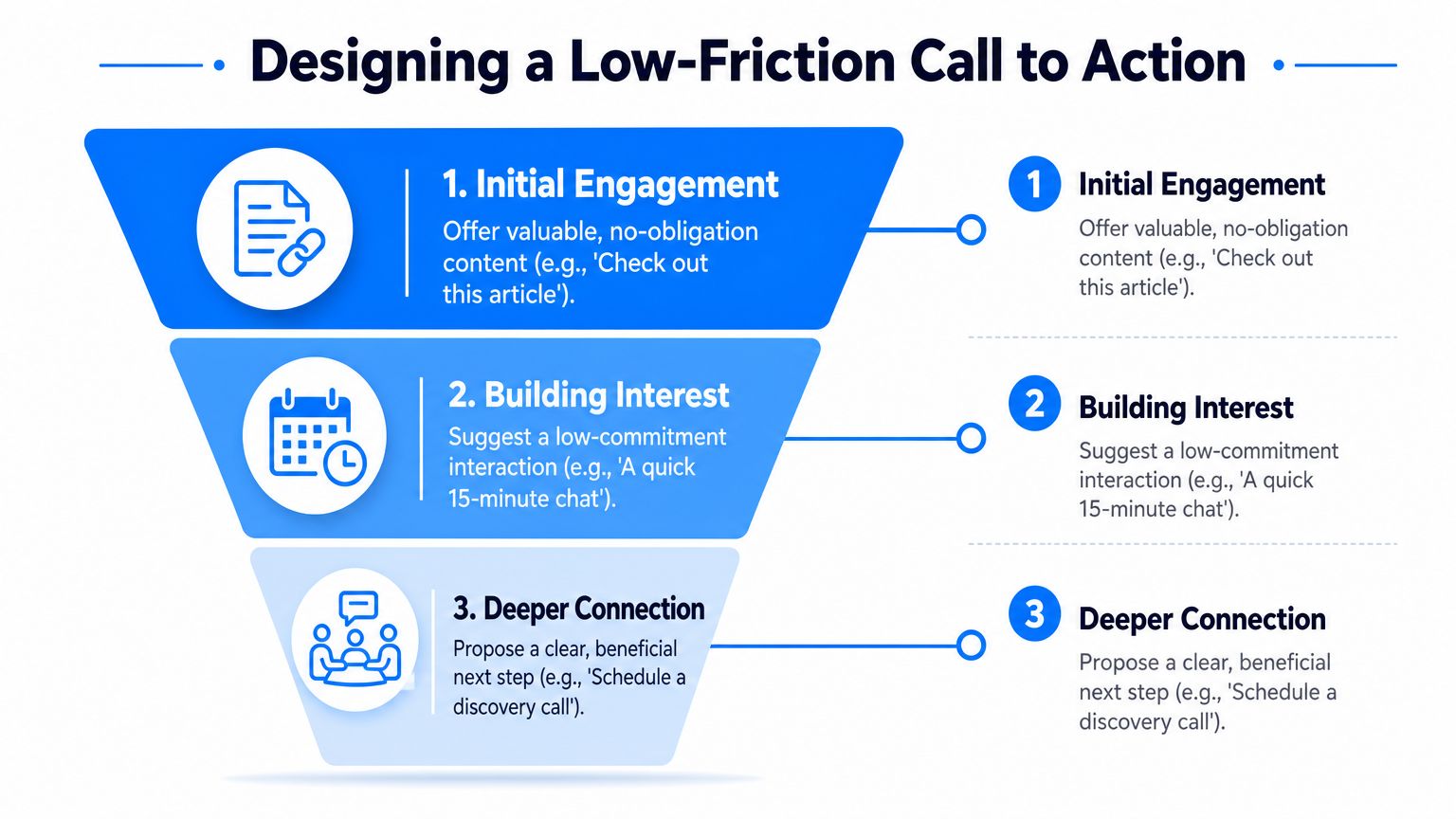
A better CTA lowers the cost of saying yes. It asks for a small response, not a big commitment.
High-friction versus low-friction asks
Here's the difference in practice:
- High-friction: “Are you available for a 30-minute demo next week?”
- Lower-friction: “Worth sending a short example?”
- High-friction: “Can we book time to discuss this?”
- Lower-friction: “Is this something you're responsible for?”
- High-friction: “Would love to walk you through our platform.”
- Lower-friction: “Open to a quick overview if this is a current priority?”
The lower-friction version doesn't weaken the ask. It matches the relationship stage. Cold outreach should start a conversation. It shouldn't demand a commitment the message hasn't earned.
A practical explanation of this shows up in guidance on intro workflows: the email should reduce friction at every step, use a concise body, keep the subject line specific, and end with one clear next step. For warm intros, giving your mutual contact a pre-written forwardable message also improves execution, according to Revenue Grid's introduction email guide.
This quick breakdown is useful if you want another perspective on first-touch messaging:
Match the CTA to the situation
Not every intro email should ask for the same next step.
For a cold outbound email, the most effective CTA is often a lightweight qualifier. For a warm intro, the CTA can be slightly more direct because some trust already exists. For a post-event follow-up, the CTA can refer to a shared context and offer one useful asset or one short follow-up call.
A good CTA gives the recipient an easy way to engage without forcing them to make a scheduling decision on first contact.
If you're using a mutual connector, remove work from their side too. Don't ask them to “make an intro” in the abstract. Send a forwardable draft they can use as-is. That small operational step often determines whether the intro happens.
Implement a Follow-Up and Deliverability System
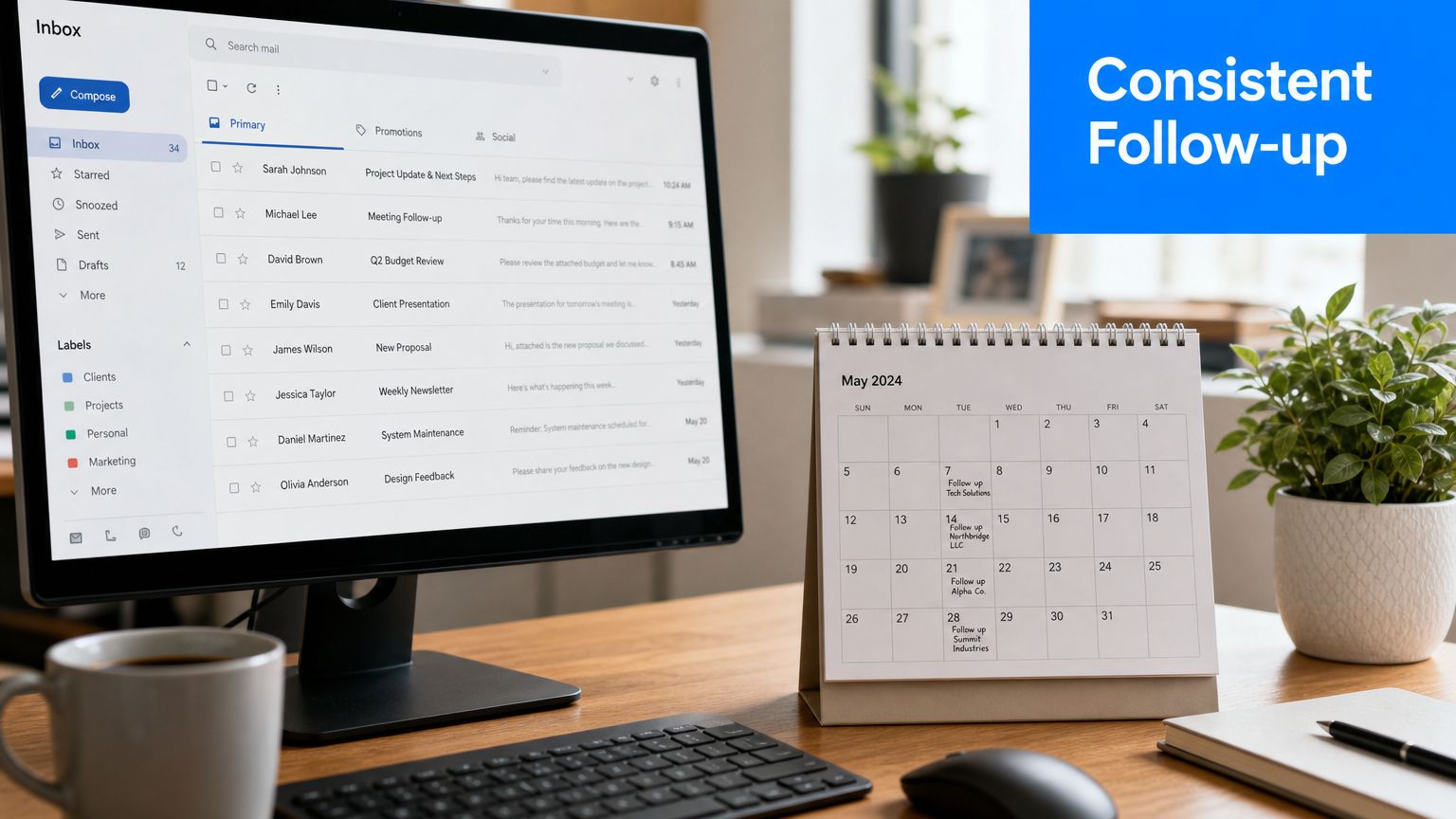
Your first email is part of a system, not a one-shot event.
A prospect scans your note between meetings, sees that it might be relevant, and leaves it for later. If your outreach depends on that first glance turning into an immediate reply, you will undercount good opportunities and overreact to weak signals. Strong business introduction emails answer why me and why now early. Strong outreach programs also give that message another chance to be seen.
Build a respectful follow-up rhythm
Follow-up works when each touch adds context, not pressure.
A practical sequence usually looks like this:
- First email: Clear relevance, specific context, one low-friction ask.
- Second email: A short follow-up that sharpens the reason for reaching out or adds one concrete detail.
- Third email: A polite closeout that invites a redirect or confirms timing is off.
This structure holds up because it respects attention. The common failure is not the number of follow-ups. It is sending the same nudge three times with no new reason to respond.
Keep the cadence tight enough to stay familiar and loose enough to avoid irritation. Campaign Monitor's review of email engagement patterns points to higher engagement on weekdays such as Tuesday and Thursday, which is directionally useful for scheduling outreach, even if timing alone will not save a weak message. See its best time to send email analysis.
Protect inbox placement while you scale
Deliverability problems distort judgment fast. If the right buyer never sees the email, teams often rewrite copy, swap CTAs, or blame the list when the issue is inbox placement.
The basics are operational, not creative:
- Use clean data: Remove invalid addresses, old contacts, and catch-all domains that never engage.
- Set up your sending domain correctly: SPF, DKIM, and DMARC should be configured before volume increases.
- Keep copy plain: Hype, forced urgency, and cluttered subject lines create friction for both filters and buyers.
- Send from a credible identity: A real sender name, company domain, and complete footer improve trust.
- Warm volume gradually: Large jumps in send volume can trigger filtering even when the copy is fine.
If your team is diagnosing placement issues, this guide to email deliverability best practices covers the main technical and operational checks. For teams building repeatable sequences, Recurrr's article on how to automate client communication effectively is useful for workflow design.
Tools help with execution, but they do not fix weak targeting or vague context. Platforms such as HubSpot, Mailshake, Instantly, and Breaker can support sequencing, list hygiene, and reporting. Breaker, for example, combines email sending with audience targeting, analytics, and deliverability management for B2B newsletter and campaign workflows.
Measuring Success and Proven Templates
A business introduction email has done its job when it creates the next useful step. Open rate can signal whether the subject line earned attention, but it does not tell you whether the message created interest, surfaced the right stakeholder, or influenced pipeline.
Track the metrics that sit closest to revenue and handoff quality. That is where weak intros get exposed.
What to track
Use a scorecard that answers two questions: did the email start the right conversation, and did that conversation go anywhere?
- Reply rate: Did the message get a response at all?
- Positive reply rate: Did the response show interest, fit, or a credible referral?
- Qualified meeting rate: Did the exchange turn into a conversation with a real buying path?
- Referral rate: Did the recipient point you to the actual owner?
- Revenue contribution: Did first-touch intro emails influence pipeline or closed business?
Tracking revenue contribution is a critical, often overlooked, step. Earlier in the article, I referenced research on welcome emails showing that first-touch messages can produce direct business value. The takeaway for outbound is not that cold email behaves like lifecycle email. It is that the first message in a relationship can create measurable return if it gives the recipient immediate context, a relevant reason to engage, and an easy next step.
That point changes how teams evaluate copy. A high-open, low-reply sequence usually means the subject line overperformed the body. A decent-open, high-positive-reply sequence is often stronger because it is attracting the right kind of attention.
Three templates that are built for replies
These templates work because they answer "Why me, why now?" before asking for anything.
Cold outreach template
Subject: Idea for [Company] outbound quality
Hi [Name],
I'm reaching out because you own [relevant function] at [Company], and I noticed [specific trigger, change, or constraint].
There may be a practical way to improve [specific outcome] without adding more manual work. If useful, I can send a short example of how other teams handle it.
Best,
[Your Name]
Why it works:
- The first sentence explains exactly why this person got the email.
- The trigger gives the message timing, not just personalization.
- The CTA asks for a small reply, which is easier than booking time cold.
Warm introduction template
Subject: Intro from [Mutual Contact]
Hi [Name],
[Mutual Contact] suggested I contact you because you're working on [initiative or priority].
I help teams address [specific problem], and the overlap looked relevant. If helpful, I can send a short summary first, or we can set up a quick call.
Best,
[Your Name]
Why it works:
- The context is immediate and credible.
- The email ties your offer to an active initiative, not a generic pain point.
- The recipient can choose the lighter next step.
Post-event follow-up template
Subject: Good to meet at [Event]
Hi [Name],
Good meeting you at [Event]. You mentioned [specific challenge or project], so I wanted to follow up while that conversation is still current.
I have a simple idea for handling [problem]. If you want, I can send over a short outline.
Best,
[Your Name]
Why it works:
- The event and remembered detail reduce cognitive load right away.
- The timing makes sense because the conversation is still recent.
- The ask stays focused on value, not calendar pressure.
The shared pattern is simple. Clear context in the first two sentences. Specific relevance tied to the recipient. One next step that feels easy to answer.
If your team wants to turn email and newsletter outreach into a more systematic B2B growth channel, Breaker is built for that workflow. It combines campaign creation, ICP-based targeting, list growth, analytics, and deliverability management in one platform, which is useful when you need more than isolated sends and want a repeatable system for reaching the right audience.
Keep reading
All articles8 Best Email Tracking Software Tools in 2026
Compare 8 top email tracking tools for 2026, how tracking pixels work, and why Apple's privacy rules make open rates unreliable. See our top pick.
6 Best Email Trackers for Newsletter Senders in 2026
Open rates lie. Learn how email trackers really work, why Apple and Gmail skew the data, and which tools newsletter senders should actually use in 2026.
Post Webinar Survey: Questions, Examples, and a Checklist
What to ask in a post webinar survey, when to send it, three example formats, and a checklist for turning the answers into segmented follow-up and pipeline.