
How to Boost Conversions With Your Email Newsletter
Turn your newsletter into a conversion engine. See 2026 benchmarks, CTR vs CVR explained, and the fixes most email guides skip.
Most marketers treat newsletters as a broadcast tool. They send updates, hope for clicks, and move on. But the subscriber list sitting in their email service provider is actually their highest-leverage conversion asset, and almost nobody optimizes it like one.
This guide starts where conversion work should always start: a clear definition, honest 2026 benchmarks, and the metrics that get mixed up most often. Then it goes where most existing guides don't. Unbounce covers landing page optimization well for paid traffic. SamCart handles checkout tactics for physical products. But neither addresses email conversion fundamentals - not segmentation, not deliverability, not subject lines, not the fact that your newsletter is a conversion funnel in its own right. That gap is exactly where this guide lives.
What Does It Mean to Boost Conversions?
Conversion rate equals the number of people who complete your intended goal divided by the number of people who had the opportunity to do it, multiplied by 100. That goal might be clicking a link, booking a call, buying a product, or replying to an email. If 1,000 people open your newsletter and 25 click through to book a demo, your conversion rate is 2.5%.
Boosting that rate rarely requires one big fix. It's usually a dozen small, compounding improvements: a sharper subject line, a more specific call-to-action, a cleaner landing page, better audience segmentation, and an inbox that actually receives your message.
Understanding Conversion Rate vs. Click-Through Rate
The difference matters, and it's where many publishers lose money without realizing it.
Click-through rate (CTR) measures how many people clicked a link out of everyone who saw the email. Conversion rate (CVR) measures how many people completed your actual goal - a purchase, signup, booking - out of everyone who had the opportunity. CTR tells you whether your message earned attention. CVR tells you whether that attention turned into revenue or pipeline.
A newsletter can have a fantastic CTR and a terrible CVR if the landing page after the click fails to deliver on the email's promise. This is one of the most common and least diagnosed problems in email marketing, and it's exactly the kind of disconnect this guide helps you fix.
| Metric | What it measures | Formula | What it tells you |
|---|---|---|---|
| Click-through rate (CTR) | Engagement with a link or CTA | Clicks ÷ Opens (or impressions) × 100 | Whether your subject line, copy, and CTA earned attention |
| Conversion rate (CVR) | Completion of the end goal | Conversions ÷ Opens or Visitors × 100 | Whether the full funnel, from email to landing page, actually closes |
What's a Good Conversion Rate? 2026 Benchmarks
A "good" conversion rate depends on the channel, industry, and what you're asking someone to do. A 2.5% conversion rate is strong for a cold landing page converting visitors into paying customers, but disappointing for an email newsletter converting engaged subscribers into webinar signups. A 10% conversion rate is excellent for most e-commerce checkouts but ordinary for a warm, segmented newsletter asking subscribers to click through to a familiar offer.
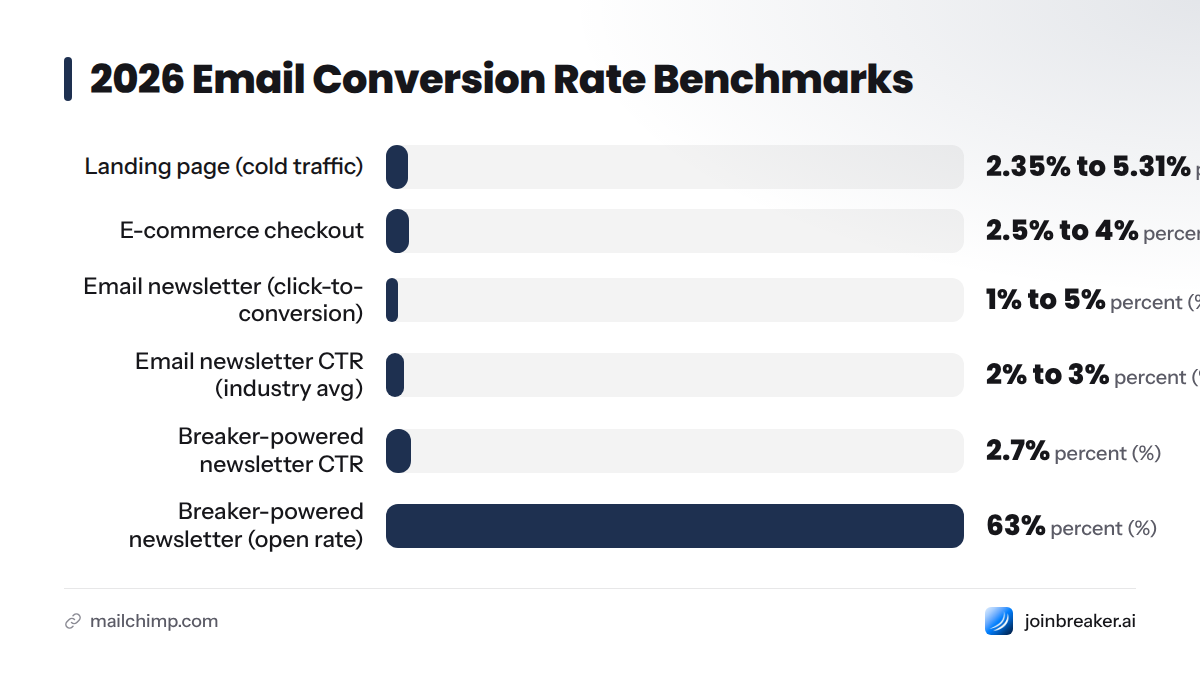
Here's how conversion rates typically break down across channels, based on published 2026 industry benchmarks and platform-level data:
| Channel | Typical average conversion rate | Notes |
|---|---|---|
| Landing page (cold traffic, PPC) | 2.35% to 5.31% | Varies heavily by industry and traffic quality, per Unbounce's conversion benchmark research |
| E-commerce checkout | 2.5% to 4% | Higher for returning customers and simplified checkouts |
| Email newsletter (click-to-conversion) | 1% to 5% | Depends on offer relevance and list segmentation |
| Email newsletter (click-through rate) | 2% to 3% average, per the Mailchimp email marketing benchmarks report | Higher for niche B2B lists with strong segmentation |
| Breaker-powered newsletters (open rate) | 63% average | Across active customer sends |
| Breaker-powered newsletters (CTR) | 2.7% average | Roughly double common industry CTR benchmarks |
Those Breaker numbers reflect platform averages across customers using segmentation, send-time optimization, and AI-assisted copywriting. They illustrate what's possible when a newsletter is treated as a conversion engine instead of a broadcast tool, not a guarantee for every list on day one.
Why Your Newsletter Is Your Most Underused Conversion Channel
Paid traffic vanishes the moment you stop paying for it. Social reach gets throttled by algorithms you don't control. Your email list works differently. It's an owned, compounding asset. Every subscriber who opts in has already expressed interest, and every open is a chance to move them closer to a sale, a booked call, or a renewal - without paying a platform for the privilege.
Most newsletters are optimized for opens and almost nothing else. Teams obsess over subject lines, celebrate when open rates climb, and rarely circle back to ask whether those opens turned into revenue. This blind spot costs businesses millions annually.
The gap is instructive: industry-wide email CTR hovers around 2% to 3%, according to Mailchimp's benchmark data, while Breaker's platform average sits at 2.7%, with open rates averaging 63% across active sends. That lift doesn't come from luck. It comes from pairing segmentation, send-time optimization, and AI-assisted personalization with disciplined testing.
The Newsletter Conversion Funnel: Subscribe - Engage - Convert
Every newsletter conversion follows a three-stage path, whether you're running a B2B publication, a creator newsletter, or a sponsor-supported media brand.
- Subscribe: Someone joins your list through a landing page, lead magnet, or referral. This stage is about trust and clarity of value, not yet about selling anything.
- Engage: The subscriber opens emails, clicks links, and builds a pattern of interaction that signals real interest. Segmentation and relevance matter most here.
- Convert: The subscriber takes your intended action - buying, booking, replying, renewing. This stage depends on your CTA, your landing page, and how well the offer matches what you learned about them during engagement.
Treating these as one undifferentiated audience is the single biggest reason newsletters underperform. A brand-new subscriber and a three-year reader who clicks every week should never receive the same pitch at the same cadence. If you want a deeper framework for mapping subscribers across these stages, Breaker's guide to newsletter funnel strategy breaks down how to structure campaigns around where each reader actually sits.
15 Proven Tactics to Boost Email Conversions
Craft Subject Lines That Drive Opens
Nothing converts if the email never gets opened. Specificity beats cleverness almost every time. "3 pricing mistakes costing you subscribers" outperforms "You won't believe this" with most professional audiences because it sets a clear, credible expectation. Test number-based subject lines, question-based ones, and curiosity-driven ones against each other. Track which style your audience rewards. Breaker's newsletter headline examples and guide to B2B subject lines that actually get opened are useful starting points if you're rebuilding your process from scratch.
Write CTAs That Convert, Not Just Get Clicks
"Learn more" gets clicks. "Book your 15-minute strategy call" gets conversions because it tells the reader exactly what happens next and what it costs them in time or money. Every CTA should answer three questions in the reader's head: what do I get, what does it cost, and what happens right after I click. Vague CTAs inflate CTR while quietly starving your actual conversion rate - one of the most common problems in email marketing.
Segment Your Audience for Relevance
A newsletter sent to everyone is optimized for no one. Segmenting by behavior (what they've clicked before), lifecycle stage (new subscriber versus loyal reader), or stated interest (from a signup form) lets you send offers that actually match what each group wants. Segmented campaigns consistently outperform one-size-fits-all sends because relevance is the biggest driver of conversion. Breaker's breakdown of how segmented campaigns boost lead generation walks through practical ways to build your first segments without overcomplicating your workflow.
Use AI to Personalize at Scale
Manually writing different versions of every email for every segment doesn't scale. AI-assisted drafting changes that equation. Modern tools can generate subject line variants, adjust tone for different segments, and suggest send times based on subscriber history - all without multiplying your workload. This is where tools built on Model Context Protocol (MCP) matter: they pull real subscriber data into the drafting process, so personalization is grounded in actual behavior rather than generic templates.
Score Subscriber Intent to Prioritize High-Value Leads
Not every click means the same thing. A subscriber who opens every email but never clicks behaves differently from one who clicks every pricing link. Intent scoring assigns a numeric value to subscriber behavior so your team knows who to prioritize. Breaker's newsletter engagement score approach turns raw open and click data into a ranked list of who's actually ready to buy.
Optimize Send Time and Frequency
Sending at 9am on Tuesday because that's tradition isn't a strategy. Test send times against your specific audience's actual open patterns, and watch frequency carefully. Too few emails and you lose top-of-mind relevance. Too many and subscribers ignore you or unsubscribe. There's no universal best time - only the best time for your list, which you find by testing.
Design Mobile-First Emails
More than half of email opens happen on phones. A newsletter that looks great on a monitor but breaks on a 6-inch screen leaves conversions on the table before the reader finishes scrolling. Use single-column layouts, large tappable buttons instead of tiny text links, and short paragraphs that don't require zoom-to-read.
Use Dynamic Content Blocks
Dynamic content lets a single email template show different images, offers, or copy blocks depending on who's opening it, without building a separate campaign for every segment. A B2B newsletter might show a case study relevant to the reader's industry, while an e-commerce brand might show products based on past purchases. Breaker's guide to dynamic content in email marketing covers how to set this up without needing a developer for every send.
Build Trust With Social Proof and Case Studies
Specific, named results beat vague claims every time. "We helped a 40-person SaaS team cut churn by 18% in one quarter" earns more trust than "Our customers love us." Weave short, specific proof points into your newsletter copy, especially right before a CTA, where skepticism is highest.
Create Urgency Without Sounding Spammy
Real urgency works. Fake urgency destroys trust fast. If a cart closes Friday or a price increases next month, say so plainly and let the deadline do the work. Avoid countdown gimmicks on offers that never actually expire. Subscribers notice, and the next "urgent" email gets ignored.
Optimize Your Newsletter Landing Page
Every CTA in your newsletter sends traffic somewhere, and that destination page determines whether the click becomes a conversion. The page should match the promise made in the email exactly, load fast, and ask for one clear next action, not five competing ones. Breaker's guide to newsletter landing page optimization covers the specific elements - from headline match to form length - that most commonly cause high-CTR campaigns to still convert poorly.
Fix Deliverability Issues Before Optimizing Copy
An email that lands in spam converts at exactly 0%, no matter how good the subject line or CTA is. Before testing new copy, confirm your sending domain has SPF, DKIM, and DMARC properly configured. These authentication protocols let mailbox providers verify you're a legitimate sender rather than a spoofed one, as outlined in the Federal Trade Commission's CAN-SPAM Act compliance guidance. Breaker's email authentication glossary entry explains what each protocol does in plain terms if you're unsure whether yours is set up correctly. Deliverability is the most overlooked conversion lever in email marketing because teams assume an email was seen simply because it was sent.
A/B Test Everything
Subject lines, CTA copy, button color, send time, preview text, sender name - all of it is testable. Run one variable at a time so you know what actually caused the lift. Give each test enough volume to reach a meaningful result before declaring a winner. Tools like Wingify's VWO platform are purpose-built for structured testing beyond your ESP's native split-test feature.
Nurture With Triggered and Welcome Sequences
The highest-converting email most brands send is also the one they spend the least time on: the welcome email. New subscribers are at peak interest the moment they join, and a strong welcome email sequence capitalizes on that window. Pair it with triggered emails that respond to specific behavior, like a reminder after someone clicks a pricing link but doesn't convert. Breaker's newsletter automation setup guide walks through building both without needing a full marketing automation platform.
Track the Right Metrics to Know What's Working
You can't improve a conversion rate you're not measuring past the open. Open rate and CTR tell you about engagement. CVR and revenue per email tell you about business impact. Breaker's 16 metrics to track for newsletter success and the companion newsletter engagement metrics guide lay out which numbers actually correlate with revenue versus which just feel good on a dashboard.
Quick Wins vs. Long-Term Plays: Effort-vs-Impact Matrix
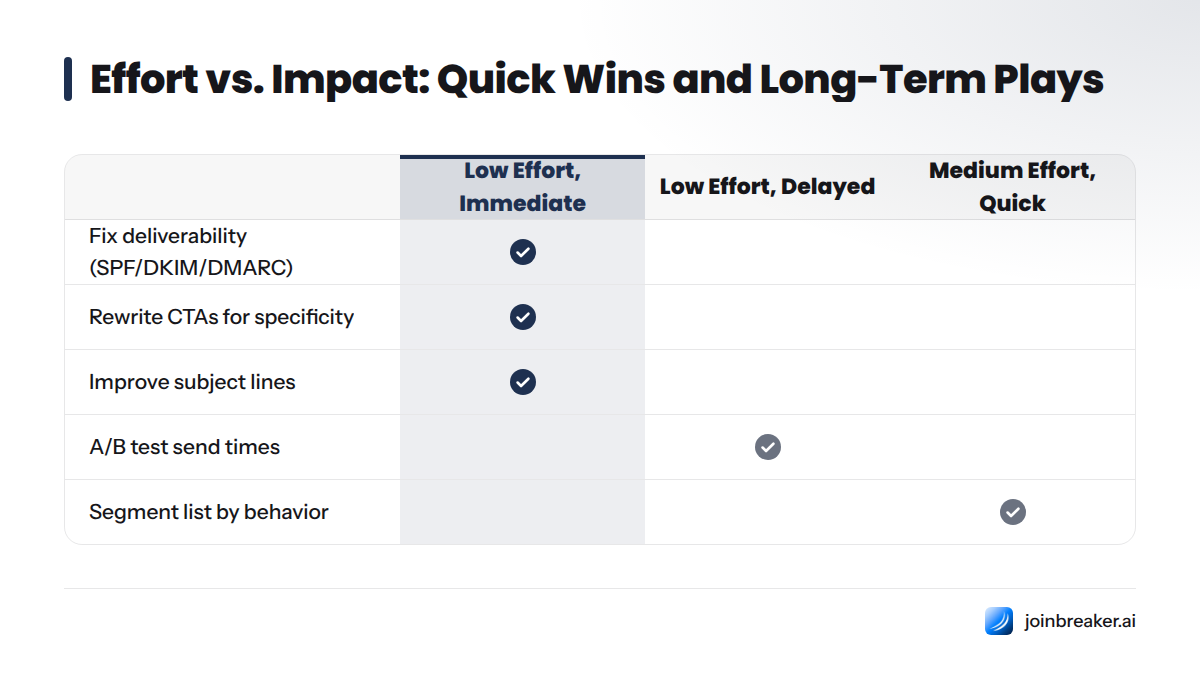
Not every tactic deserves equal attention this week. Some fixes take fifteen minutes and move the needle immediately. Others take months to build but compound over time. Here's how the fifteen tactics above stack up:
| Tactic | Effort | Time to impact | Expected lift |
|---|---|---|---|
| Fix deliverability (SPF/DKIM/DMARC) | Low | Immediate | High |
| Rewrite CTAs for specificity | Low | Days | Medium to high |
| Improve subject lines | Low | Immediate | Medium |
| A/B test send times | Low | 1-2 weeks | Medium |
| Add social proof near CTAs | Low | Days | Medium |
| Mobile-first redesign | Medium | 1-2 weeks | Medium |
| Build welcome sequence | Medium | 2-4 weeks | High |
| Optimize landing page match | Medium | 1-2 weeks | High |
| Segment the list by behavior | Medium | 2-4 weeks | High |
| Add triggered emails | Medium | 3-4 weeks | Medium to high |
| Set up dynamic content blocks | High | 4-6 weeks | Medium |
| Build intent scoring | High | 4-8 weeks | High |
| Deploy AI personalization at scale | High | 6-8 weeks | High |
| Full funnel audit (subscribe-engage-convert) | High | 8-12 weeks | High |
| Ongoing systematic A/B testing program | Medium (ongoing) | Continuous | Compounding |
Prioritization Framework: Your First 30 Days
Start with deliverability and clarity before touching anything advanced. Here's a week-by-week roadmap that mirrors how Breaker customers typically ramp up:
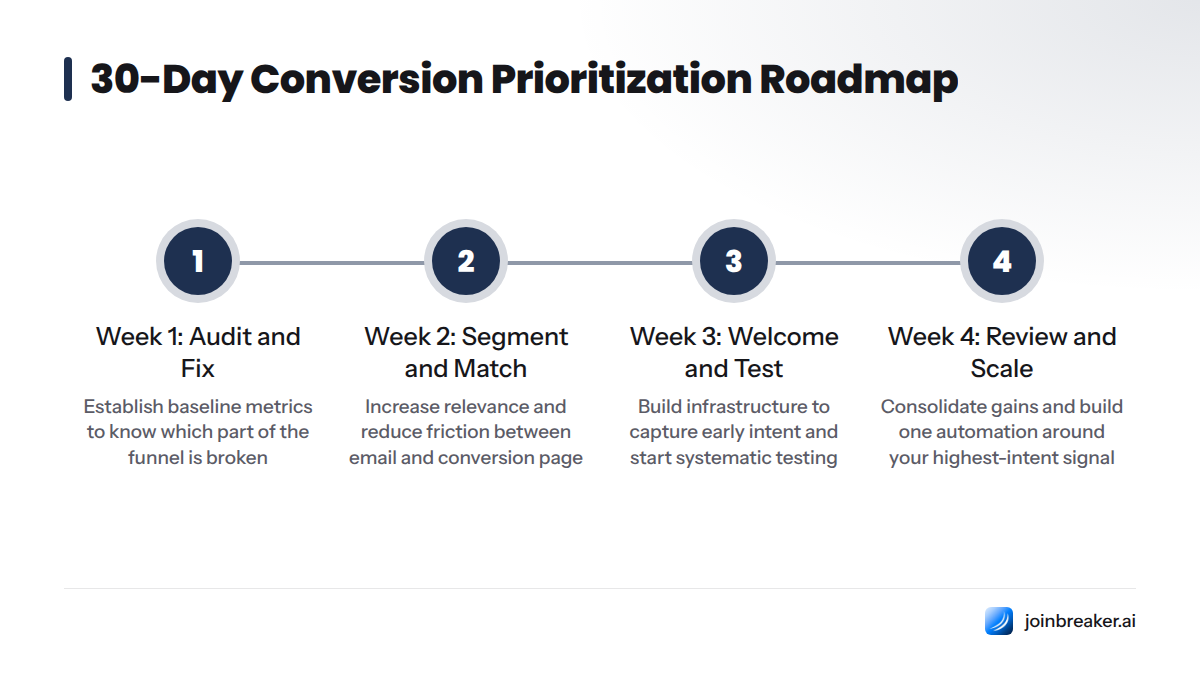
- Week 1: Audit deliverability (SPF, DKIM, DMARC), measure your CTR and CVR separately so you know which part of the funnel is actually broken, and rewrite your top three CTAs for specificity.
- Week 2: Build or refine two to three audience segments based on existing behavior data, and match your newsletter landing page copy exactly to your most-clicked email promise.
- Week 3: Launch or rebuild your welcome email sequence, and start a structured A/B test on subject lines using a consistent format you can repeat weekly.
- Week 4: Review the data from weeks 1 through 3, double down on whichever segment or CTA style outperformed, and set up one triggered email based on your highest-intent behavior signal, like a pricing page click with no follow-through.
By day 30, you should have a documented baseline for CTR and CVR separately, at least one working segment, a live welcome sequence, and one completed A/B test cycle. That's enough infrastructure to start compounding gains instead of guessing campaign to campaign.
Common Newsletter Conversion Problems (and How to Fix Them)
High Opens, No Clicks
This almost always points to a mismatch between subject line promise and body content, or a CTA that's buried, vague, or missing. Check whether your email delivers on what the subject line implied, and make sure there's one clear, visually obvious CTA rather than three competing links.
High Clicks, No Conversions
If people are clicking but not converting, the problem usually lives on the landing page, not in the email. Confirm the page headline matches the email's promise, the form isn't asking for more information than the offer justifies, and the page loads quickly on mobile. This is the CVR-versus-CTR gap described earlier: healthy CTR with weak CVR means the breakdown happens after the click.
High Unsubscribes After a Campaign
A spike in unsubscribes right after a specific send usually means a mismatch between what subscribers signed up for and what you sent, often from over-promising urgency or sending to an unsegmented list with an offer that only applies to part of it. Review whether the campaign was relevant to everyone who received it, and consider whether better segmentation would have prevented the mismatch.
Measuring Newsletter Conversion ROI
Calculating ROI on conversion improvements comes down to comparing the value generated against the cost of running the campaign. The basic formula is: ROI = (Revenue attributed to the newsletter minus the cost of running it) divided by the cost, multiplied by 100.
Revenue per email (RPE), which measures how much revenue a single send generates on average, is one of the clearest ways to track whether your conversion improvements are actually paying off over time. Breaker's guide to revenue per email explains how to calculate it cleanly, and the newsletter ROI calculator lets you plug in your own numbers instead of estimating by hand.
For automation-specific ROI, Breaker's piece on how to calculate ROI for newsletter automation is worth a look if you're weighing triggered sequences versus one-off campaigns.
Tools That Help You Boost Email Conversions Faster
| Tool | Best for | Why it stands out |
|---|---|---|
| Breaker (joinbreaker.ai) | Newsletter growth, segmentation, AI drafting, and conversion tracking in one platform | Combines TruSend's deliverability-first sending infrastructure, RealClick's accurate click tracking, an audience graph for intent scoring, and AI-assisted drafting, all built specifically for newsletter conversion rather than bolted onto a generic ESP |
| ActiveCampaign (activecampaign.com) | CRM-integrated email automation | Strong for teams needing deep CRM syncing alongside email sends |
| Wingify VWO (vwo.com) | A/B testing landing pages and websites | Purpose-built split-testing suite, best paired with a separate ESP |
| Unbounce (unbounce.com) | Landing page building and PPC-driven conversion | Strong for paid traffic landing pages, not built for newsletter sending |
Breaker's advantage for newsletter-specific conversion work comes down to how the pieces connect. TruSend handles sending with deliverability baked into its infrastructure, so you're not fighting spam folders before you test copy. RealClick provides accurate, bot-filtered click data so your CTR reflects real human behavior. The audience graph builds intent scores automatically from engagement patterns, and the AI drafting layer, grounded in real subscriber data through MCP-style integration, adjusts copy for different segments without the manual lift of building five versions by hand.
For teams trying to boost conversions without hiring a full lifecycle marketing team, that combination is hard to match with a generic ESP plus separate tools bolted on the side.
If you're earlier in the growth journey and still building your list, Breaker's email list growth hacks guide is a useful companion.
For a broader look at how newsletters fit into company growth, including product-led signals, Breaker's product-led growth email tips piece is a solid next read.
FAQs
How do you boost conversion rate?
Clarify your CTA, match your landing page to your message, segment your audience so offers are relevant, fix any deliverability or trust issues that block people from seeing your message, and test one variable at a time to find what actually moves the needle.
What is the difference between CVR and CTR?
CTR measures how many people clicked a link out of everyone who saw it. CVR measures how many people completed your actual goal - a purchase or signup - out of everyone who had the opportunity. Healthy CTR with weak CVR usually points to a problem after the click, not in the email itself.
Is a 2.5% conversion rate good?
A 2.5% conversion rate is solid for a cold landing page converting visitors into customers, roughly in line with typical benchmarks of 2.35% to 5.31% reported by Unbounce. For a warm, segmented email newsletter, 2.5% is modest and usually has room for improvement through better targeting.
Is a 10% conversion rate considered good?
A 10% conversion rate is excellent across almost every channel, including e-commerce checkout, email, and landing pages. It typically reflects a highly relevant offer sent to a well-matched, warm audience rather than cold traffic.
What is a good email newsletter conversion rate in 2026?
A good newsletter conversion rate (clicks that lead to the final goal) typically falls between 1% and 5%, depending on the offer and audience warmth. A strong click-through rate sits around 2% to 3% industry-wide, with top-performing, well-segmented lists reaching higher.
How long does it take to see conversion rate improvements?
Simple fixes like CTA rewrites or deliverability corrections can show results within a single send cycle, often one to two weeks. Structural changes like segmentation or intent scoring typically need four to eight weeks of data before the lift becomes statistically clear.
Can AI really improve newsletter conversions?
Yes, when the AI has access to real subscriber behavior data rather than generic templates. AI-assisted drafting and segmentation tools that pull from actual engagement history, such as those built on Model Context Protocol-style data access, can personalize subject lines, send times, and copy at a scale manual writing can't match.
What's the fastest way to boost conversions this week?
Check your email authentication setup first, since a deliverability problem blocks every other improvement. Then rewrite your top CTA to be specific about what happens after the click. Both changes can be made within a day and often show measurable impact in your next send.
Key Takeaways
- Boosting conversions means increasing the share of people who complete your intended goal, not just the share who click.
- CTR and CVR measure different things. Strong CTR with weak CVR points to a landing page or offer problem, not an email problem.
- Typical 2026 benchmarks: 2.35% to 5.31% for cold landing pages, 1% to 5% for newsletter conversions, and 2% to 3% average newsletter CTR industry-wide, with Breaker's platform averaging 63% opens and 2.7% CTR.
- Your newsletter is an owned, compounding conversion channel, unlike rented reach on paid or social platforms.
- Fix deliverability before optimizing copy. An email that never reaches the inbox can't convert.
- Segmentation, intent scoring, and AI-assisted personalization are the modern levers competitors in this space haven't covered.
- Prioritize using the effort-vs-impact matrix: start with low-effort, high-impact fixes like CTA clarity and authentication before investing in AI personalization or full funnel audits.
- Give structural changes four to eight weeks before judging results, and track RPE alongside CVR to connect conversion work directly to revenue.
Sources
Keep reading
All articlesDrip Campaign Template: Ready-to-Use Email Sequences
Get 6 ready-to-paste drip campaign templates with subject lines, body copy, and send timing—plus a step-by-step guide to building your own.
Post-Webinar Survey Questions Template (2026)
30+ post-webinar survey questions with NPS, CSAT, and CES templates, plus timing and length tips to boost completion and qualify leads faster.
GDPR Consent Requirements for Purchased Email Lists
Purchased email lists rarely meet GDPR's consent bar. Learn the legal basis rules, PECR overlap, and safer alternatives before you hit send.